The $5 Panic: Why Your Watch Isn't Killing You
You are $100,000 in the hole, and you are stressing about five dollars. That is the honest summary of the viral EMF panic. A wave of social media claims insists that wearing a smartwatch "blocks your meridians," "disrupts your organs," and is "a hundred times worse on your wrist." This article takes each claim, holds it against the actual evidence, and then puts the whole question in perspective against the factors that genuinely move your healthspan.
The claim going viral
"When you put EMF anywhere on your body, it blocks the flow of the meridians and also blocks the flow of your fascia. It disrupts your organs, especially your large intestine, your lungs, and your heart. It's a hundred times worse on your wrist." (Viral social media claim, 2025)
This sounds terrifying. It is also completely fabricated. Let us break down each assertion.
"EMF blocks your meridians and fascia"
Completely fabricated. There is no scientific evidence in any peer-reviewed literature that radiofrequency EMF from consumer devices "blocks" meridian flow or fascia function. The concept of meridians itself remains without established anatomical basis. The claim conflates unvalidated traditional medicine concepts with fabricated EMF pseudoscience. (Sources: Frontiers in Neuroscience; PLoS One systematic review.)
"It disrupts your organs: intestine, lungs, heart"
Zero supporting evidence. The specific claim that a smartwatch causes pain and organ disruption to the large intestine, lungs, and heart has no support in the literature. The organs listed appear to be borrowed from traditional Chinese medicine meridian maps, not from any biomedical research. (Source: WHO systematic review of human experimental studies.)
"It's a hundred times worse on your wrist"
False as stated. While specific absorption rate (SAR) does decrease with distance, the actual SAR values from wearable devices are extremely low. Dosimetry studies found maximum average SAR on skin of approximately 50 to 54 mW/kg, roughly 30 to 40 times below the FCC safety limit of 1.6 W/kg. The "100 times worse" figure is an invented number with no scientific basis. (Source: Bioelectromagnetics dosimetry studies.)
"EMF is bad for you, it's generally known"
Misleading. It is not "generally known" that EMF from consumer devices is harmful. A JAMA Oncology review concluded that the FDA found no clear evidence of radiofrequency radiation being associated with tumorigenic effects in the 37 relevant studies it identified. IARC's Group 2B classification ("possibly carcinogenic") is the weakest positive classification available, the same category that includes pickled vegetables. (Sources: JAMA Oncology; WHO systematic reviews.)
The physics: non-ionizing radiation cannot break DNA bonds
The electromagnetic spectrum is divided by one critical threshold: does the radiation carry enough energy to knock electrons off atoms and break chemical bonds? Everything below ultraviolet, which includes radio waves, microwaves, infrared, and visible light, is non-ionizing. It literally does not carry enough energy to damage a cell, let alone your DNA.
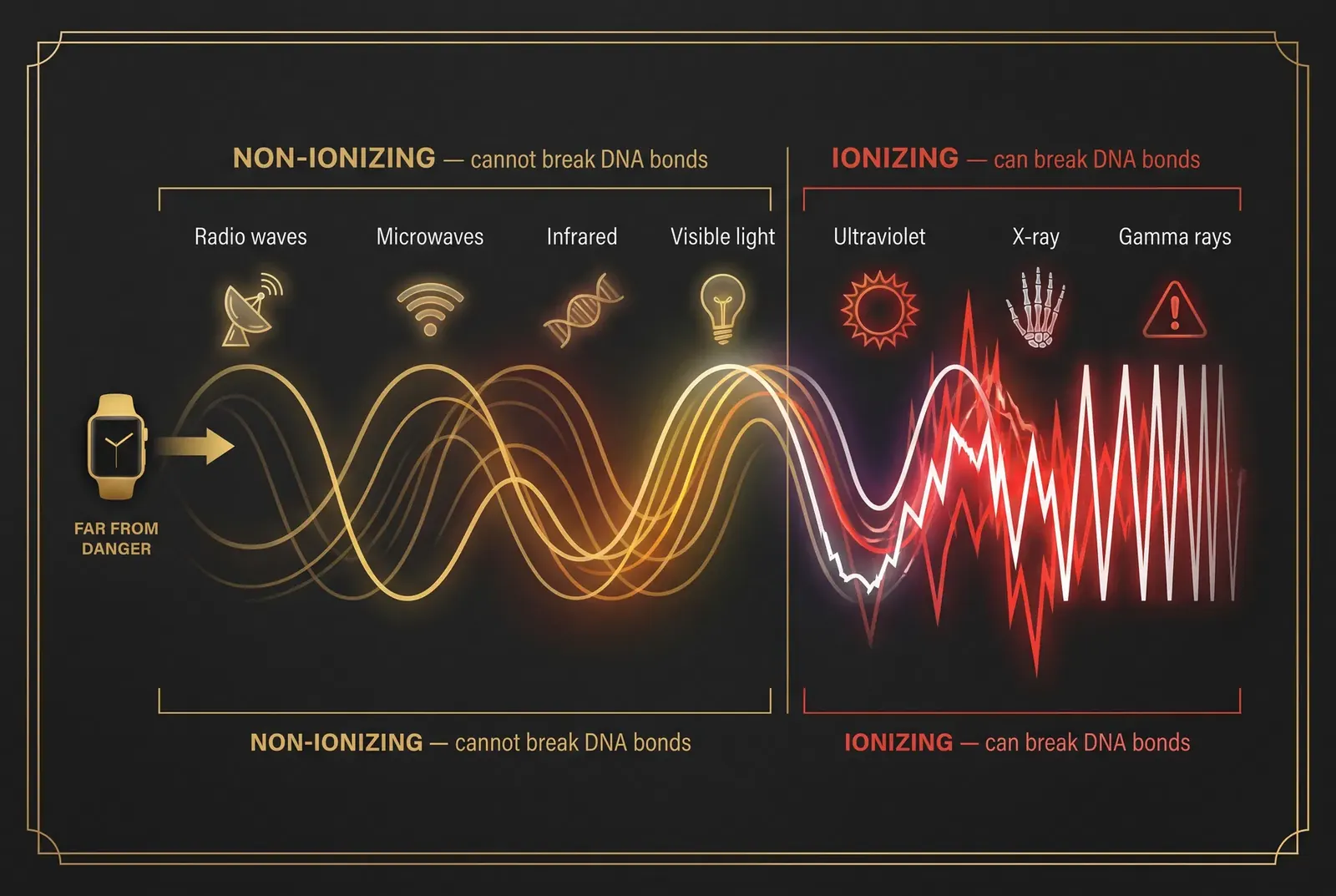
The power levels involved put this in perspective. Your smartwatch transmits at roughly 10 to 50 milliwatts. A cell tower transmits at 10 to 50 watts. The NTP rat study, the source of most of the alarming headlines, used reverberation chambers at 30 to 120 times the exposure of a consumer device.
There is one more mechanism worth naming: the nocebo effect. A WHO-commissioned systematic review found that the symptoms people attribute to EMF track perceived exposure, not actual exposure. The fear itself causes the symptoms.
Protectif mineral SPF 50+. Broad-spectrum protection with GMA7 repair complex. The one daily step that changes outcomes. Shop now →
The "scary" studies
The positive findings that fuel EMF panic come predominantly from in vitro cell cultures and whole-body rodent exposures at SAR levels of 1.5 to 6 W/kg for 9 hours per day. Those conditions are 30 to 120 times higher than what a consumer smartwatch produces at the skin (~50 mW/kg). There is no version of that exposure on your wrist.
Your watch operates at 0.83% of what the rat study used. To achieve the whole-body SAR levels used in the NTP study on a human, you would need either an extraordinarily powerful source or extremely close proximity to a high-power industrial or military transmitter, not a consumer wearable. The key scaling problem is that RF energy falls off with the inverse square of distance, and consumer devices operate at milliwatt power levels. The "scary data" has no consumer analog.
The health bank account
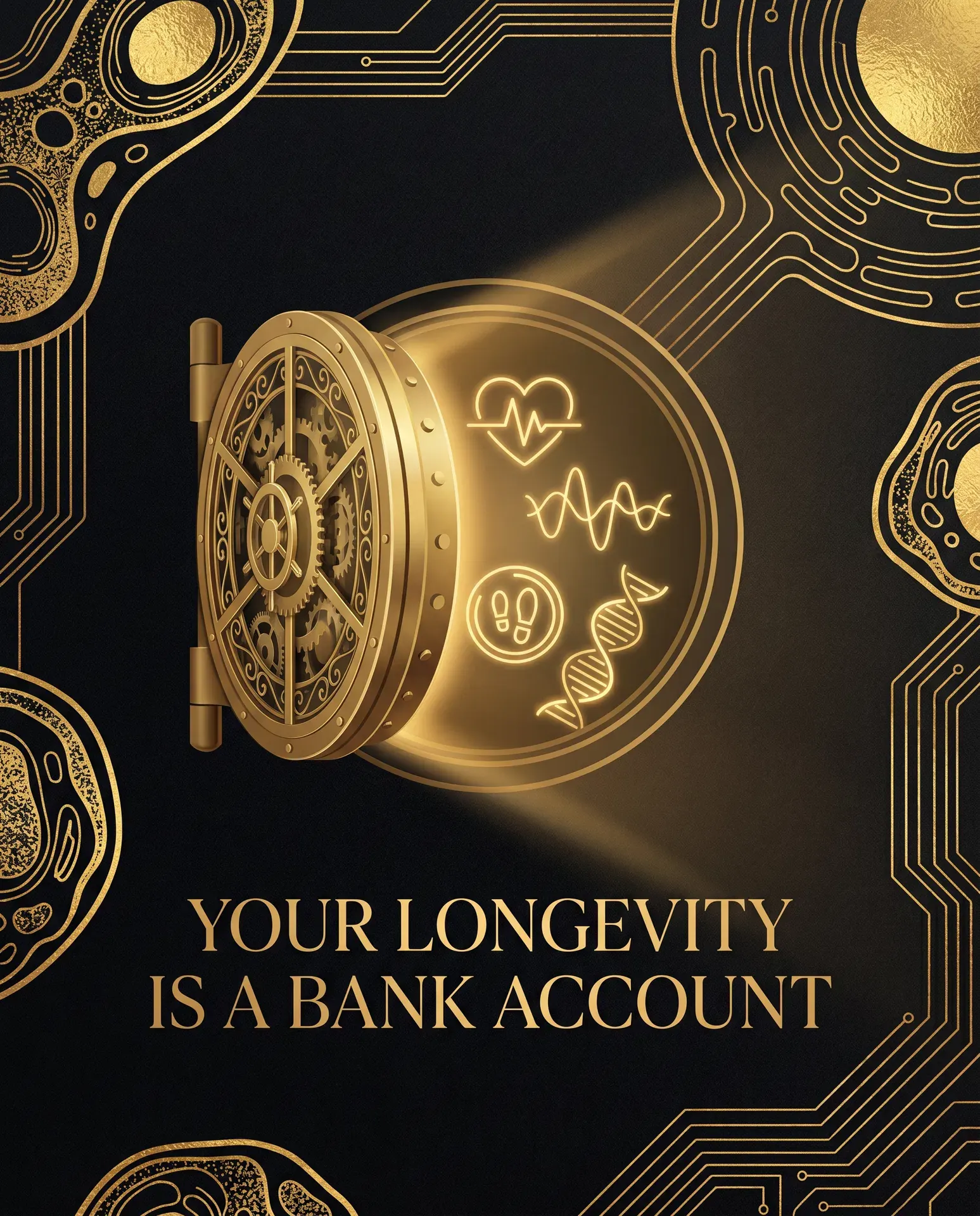
Picture your longevity as a bank account. Harmful behaviors drain it. Protective behaviors deposit into it. Every factor has a real "monthly rent" based on its hazard ratio from large epidemiological studies. Smoking is a $100,000 per month habit draining the account. A sedentary life costs about $50,000. Bad sleep, roughly $25,000. Your watch's EMF, if it costs you anything at all, and the evidence says it does not, is maybe five dollars.
| Health factor | Evidence | Monthly "rent" |
|---|---|---|
| Current smoking (1+ pack/day) | HR 2.09–2.78 | −$100,000 |
| Poor diet + obesity + no exercise + smoking | HR ~0.26 for 5 healthy factors vs 0 | −$150,000 |
| Physical inactivity (sedentary) | HR ~1.38 vs active | −$50,000 |
| Light or nondaily smoking | HR ~1.50 all-cause | −$40,000 |
| Sleep of 5 hours or less per night | HR 1.29–1.54 | −$25,000 |
| 5 healthy lifestyle factors combined | +12–14 years life expectancy | +$100,000 |
| High exercise (3–5× guidelines) | ~40% mortality reduction | +$60,000 |
| Regular exercise (150 min/week) | ~30% mortality reduction | +$50,000 |
| Adequate sleep (7 hours) | Reference/optimal | +$20,000 |
| Consumer EMF (smartwatch, phone, WiFi) | No consistent evidence; HR ~1.0 | −$0 to −$500 |
The scaling is anchored to smoking as the reference "worst apartment" at roughly $100,000 per month (HR ~2.4 to 2.8). Sources: Li et al., Circulation 2018; European Journal of Epidemiology; WHO/FCC/ICNIRP. The dollar figures are an illustrative analogy anchored to real hazard ratios, not literal financial costs.
The irony nobody talks about
The fear-monger wants you to throw away a measurement tool. Your watch tracks the exact inputs that determine whether you are depositing into or draining your longevity account: heart rate variability, which predicts cardiovascular risk; sleep architecture, where sleep of 5 hours or less carries a hazard ratio of 1.29 to 1.54; daily movement, where 150 minutes per week is associated with roughly a 30% mortality reduction; and estimated VO2 max, the strongest predictor of all-cause mortality.
Cutting one cigarette a day does more for your life than taking that watch off ever could.
The investment case
In medicine, we constantly evaluate whether benefit outweighs risk. Chemotherapy has devastating side effects, but it saves lives. Statins can cause muscle pain, but they prevent heart attacks. For wearable health tracking, the math is not even close.
The cost: theoretical EMF exposure at 0.83% of what harmed rats in a chamber, no consistent evidence of harm in humans, hazard ratio near 1.0. In the bank account analogy, maybe $5 per month, if anything.
The benefit: continuous measurement of heart rate, sleep, activity, and recovery. That data enables behavior change worth $50,000 to $100,000 per month in the same analogy. Even if EMF costs you $5, and it probably does not, the data returns $50,000 or more. That is a 10,000:1 benefit-to-risk ratio, and it makes the wearable one of the better longevity investments available. There is also an opportunity cost to the anxiety itself: worry that disrupts sleep or discourages use of health-monitoring features may be more costly than the EMF exposure.
Honest nuance: the real (minor) wearable concerns
Science is honest about uncertainty. We do not claim absolute safety for anything. But the legitimate, minor wearable concerns are not EMF at all:
- PFAS in some watch bands. Some fluoropolymer bands may contain PFAS ("forever chemicals"). This is a real materials concern, but it is about the band, not the signal. Choose silicone or titanium bands.
- Health anxiety from over-monitoring. Constantly checking metrics can increase anxiety in some people. The solution is structured check-ins, not abandoning measurement entirely.
- Rare pacemaker interference. Strong magnets in some devices can theoretically affect implanted cardiac devices at very close range. Real, but extremely niche, and relevant only to a specific population.
If you want a real watch worry, it is the band chemicals, not the signal. Even that is manageable with material choice. The EMF panic is a distraction from what actually matters.
What we measure
At our clinic, measurement is everything. We do not guess, we quantify. And the tools we use to track skin biological age and treatment response are themselves "EMF-emitting" devices. The irony is not lost on us.
- VISIA Complexion Analysis. Multi-spectral imaging captures UV damage, porphyrins, brown spots, red areas, wrinkles, texture, and pores, quantifying what the naked eye cannot see.
- Evolab Insight. Measures skin barrier function, hydration, sebum balance, and elasticity at the cellular level, tracking how living tissue responds over time.
- Skin Life Analytics. Our integrated platform combines multi-spectral camera data with clinical assessment to produce a biological skin age score and track how it changes with each intervention. Learn more about our diagnostics.
The biggest risk is almost never the one going viral. Stop paying the five-dollar bill. Go after the hundred-thousand-dollar one.
Frequently asked questions
Is EMF from my smartwatch dangerous?
Based on the current body of evidence from WHO, FCC, ICNIRP, and CDC, there is no confirmed risk from consumer RF-EMF at the levels emitted by smartwatches. A smartwatch operates at SAR levels roughly 30 to 40 times below the FCC safety limit. The positive findings in the literature come from rodent studies at 30 to 120 times the exposure levels of consumer devices, conditions with no real-world analog.
What about the NTP rat study that found cancer?
The NTP study exposed rats to whole-body SAR of 1.5 to 6 W/kg for 9 hours per day inside specialized reverberation chambers designed to maximize absorption. A smartwatch produces about 50 mW/kg on skin, which is 0.83% of what the study used. To achieve those levels on a human, you would need an extraordinarily powerful industrial transmitter, not a consumer wearable.
What does "non-ionizing" mean?
The electromagnetic spectrum is divided by whether radiation carries enough energy to break chemical bonds in DNA. Everything below UV, including radio waves, microwaves, infrared, and visible light, is non-ionizing. It physically cannot damage DNA through the ionization mechanism. Your watch emits radio waves, the lowest-energy end of the spectrum, far from the danger zone.
Why recommend a smartwatch if there is any uncertainty?
Every medical decision is a benefit-risk analysis. The theoretical EMF cost, if any, is negligible: perhaps $5 per month in the health bank account analogy. The benefit of continuous monitoring of heart rate, sleep, activity, and VO2 max enables behavior changes worth $50,000 to $100,000 per month in the same analogy. That is a 10,000:1 ratio. The anxiety about EMF, which can disrupt sleep and discourage health tracking, may actually be more harmful than the exposure itself.
What are the real risks of wearable devices?
The legitimate concerns have nothing to do with EMF: PFAS in some fluoropolymer watch bands (choose silicone or titanium instead); health anxiety from over-monitoring in some individuals (use structured check-ins); and rare pacemaker interference from strong magnets at very close range, relevant only to people with implanted cardiac devices.
What about "electro-hypersensitivity" (EHS)?
WHO-commissioned systematic reviews of human experimental studies found that acute RF-EMF exposure below regulatory limits does not cause self-reported symptoms, and that symptoms reported in everyday life are related to perceived, not actual, EMF exposure status. This is essentially a nocebo effect. The fear causes the symptoms, not the signal.
Verifiable sources
- WHO/FCC/ICNIRP/CDC: no confirmed risk from consumer RF-EMF at population-relevant exposure levels.
- FCC SAR limit 1.6 W/kg; Apple Watch approximately 0.07–1.15 W/kg (skin ~50 mW/kg). FCC Equipment Authorization.
- NTP Toxicology Studies of Cell Phone Radiofrequency Radiation (whole-body SAR 1.5–6 W/kg, ~9 h/day in reverberation chambers).
- IARC: RF-EMF is Group 2B ("possibly carcinogenic"), the weakest positive classification. IARC Monographs Vol 102.
- WHO systematic review: EHS symptoms are nocebo (perceived, not actual, exposure). Environment International.
- Li Y, et al. Impact of Healthy Lifestyle Factors on Life Expectancies. Circulation. 2018;138(4):345–355.
- JAMA Oncology review: FDA found no clear evidence of RFR tumorigenic effects in 37 studies.
Where this fits at Sajic Longevity. Instead of panicking about five dollars, a physician assessment quantifies your real longevity risks with objective diagnostics and builds a plan that moves the numbers that count. Book a consultation or call 1-888-430-4665.
Worry about what is actually measurable.
The radiation that ages skin is ultraviolet, not your watch. Put the effort where the evidence is.
How we measure instead of guess
Baseline, treat, re-measure. The loop behind every protocol.
Read more → BookBook a consultation
Start with a private virtual consultation. Your deposit is applied to diagnostic testing.
Book now → Shop Sajic Skin ScienceProtectif mineral SPF 50+
Broad-spectrum protection with GMA7 repair complex. The one daily step that changes outcomes.
Shop now →Not sure which is right for you? Call 1-888-430-4665 or email consult@sajicskin.com and our team will point you to the right starting point.
This article is for education and general information only. It is not medical advice, does not establish a physician-patient relationship, and should not replace consultation with a qualified healthcare provider. Individual results vary. Treatment decisions are made only after an individual assessment.