“How Did I Get Cancer Somewhere the Sun Never Burned?”
I hear this in clinic all the time. A patient finds a cancer on an inner thigh or another protected area. Could sun exposure from 10, 20, or 30 years ago still be shaping the immune and inflammatory terrain today?
Educational information only. Testing and treatment choices require individual medical review.
Why This Question Is Personal to Me
I Grew Up in the Elements.Then I Developed Skin Cancer.
I spent the first ten summers of my life by the Adriatic Sea. I kept growing up outdoors—living, working, and moving through the elements. Years later, I developed skin cancer.
The standard message used to be: the damage is permanent. Watch it. Cut out cancers when they appear. Accept the rest. I could not accept that as the end of the story.
My mission became to ask whether we can measure the visible and invisible damage, support repair, lower the slow-cooking inflammatory noise, and prove that the biology is moving—not merely cover what the mirror shows.
That is why my work joins dermatology, inflammation science, and longevity medicine. I want to help people like me challenge the idea that accumulated damage can only be watched, never changed.
“The old goal was to find damage earlier. My goal became to measure it, repair what we can, and prove whether the system is becoming more resilient.”The Question Patients Ask Me Every Week
“How Did I Get a Cancer on My Inner Thigh? I Never Burned There.”
Not by sending UV mutations through the bloodstream. The scientifically plausible connection is theimmune and inflammatory environment around cells that may already be damaged.
Supported mechanism
UV exposure can alter immunity beyond the skin it touched.
In a 2025 study, repeated UV exposure changed circulating immune cells and produced a more immunosuppressive environment in mouse tumors growing at UV-protected sites. Preliminary human data linked molecular evidence of repeated skin UV exposure with higher circulating regulatory T cells. This is important mechanistic evidence—but it does not prove that one adolescent sunburn causes one specific distant cancer years later.[11]
01
Sun exposure accumulates
Childhood burns and years outdoors create local DNA damage while injured cells release inflammatory and immune signals.
02
The signal does not stay local
Human and animal evidence shows that UV exposure can alter circulating immune regulation beyond the treated skin.
03
A distant site has its own vulnerabilities
An inner thigh does not receive a new UV mutation from the back. It may have unrelated mutations or susceptible cells of its own.
04
The terrain may affect control
The hypothesis is that systemic immune suppression, inflammation, or senescent-cell signals could make surveillance less effective elsewhere.
This deserves its own full story.
Read the dedicated article on systemic UV signaling, immune surveillance, and “zombie” cells while I continue building the next research-focused post around this exact question.
Book a consultation. Physician-led, measured before and after. Deposit applied to testing. Book now →
Inflammation Is Not Always a Fire You Can Feel.
The 2023 Hallmarks of Aging framework names chronic inflammation as one of 12 connected drivers of aging. Dysbiosis, mitochondrial dysfunction, cellular senescence, and DNA instability can feed the same loop.[1]
It can be quiet
Chronic inflammation may rise before you feel clearly unwell.
It connects systems
Inflammation interacts with DNA damage, senescent cells, hormones, metabolism, and microbes.
It is not one number
A marker can be useful, but no single test explains the whole person.
Important: inflammation is not automatically a diagnosis, and a “high” advanced marker is not a treatment plan. Infection, training load, sleep, medications, body composition, and many diseases can change results. Context matters.
Measure What the Mirror Misses
Five Questions. Not One Magic Test.
Advanced testing works best as a ladder. Start with standard medicine. Add focused tools only when they answer a real question. Then repeat the same measure after enough time to learn what moved.
Established clinical tools
Interpretation required
The Medical Foundation
First, make sure the basics are not being missed.
What it measures. CBC, liver and kidney markers, glucose/HbA1c, lipids/ApoB, hs-CRP, thyroid, ferritin, vitamin D, B12/folate when appropriate.
Why it can help. These tests can reveal common and treatable problems that advanced testing should never replace.
What it cannot do. The exact panel depends on symptoms, medications, age, sex, and risk.
Visible + InvisibleA Better Dashboard Uses More Than a Before-and-After Photo.
We can pair standardized skin imaging with blood, epigenetic, oxidative, and microbiome data. The goal is not to collect every test. It is to choose a few that can change a decision.
Start Today · No Advanced Test RequiredThe Foundation Is Not Fancy. It Is Powerful.
A Mediterranean-style eating pattern can improve several inflammatory markers, including hs-CRP and IL-6, across randomized trials. Exercise, sleep, smoking avoidance, and stress care are the base—not an afterthought.[2]
The goal is not to hide from life. It is to live it with better protection, better recovery, and a way to check whether the plan is working.
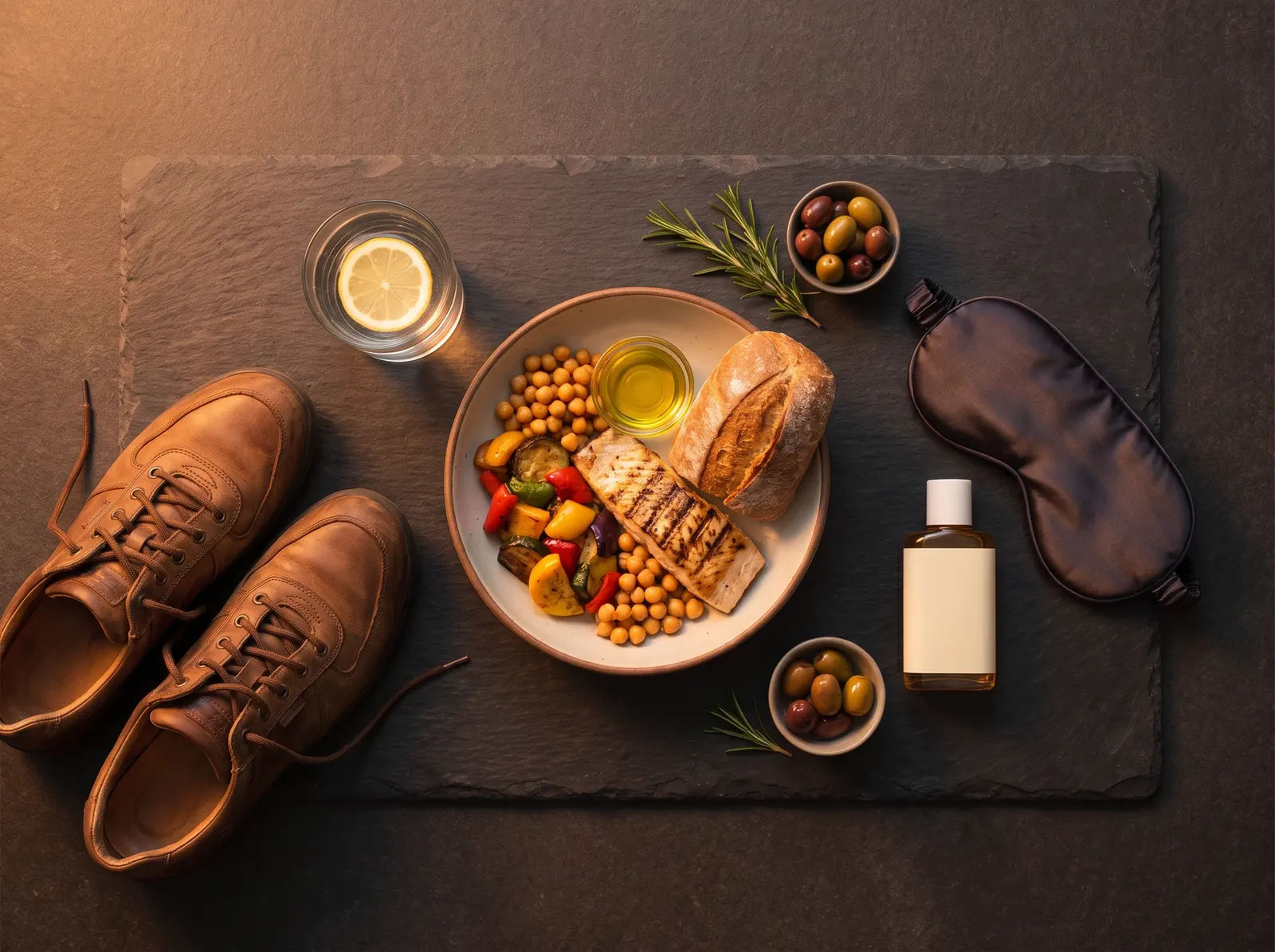
Eat for less noise
Build meals around plants, legumes, olive oil, fish, fibre, and minimally processed food.
Move most days
Combine walking, aerobic work, and strength training at a level you can recover from.
Protect sleep
A stable sleep schedule supports immune, metabolic, and stress regulation.
Lower avoidable stress
Use recovery time, relationships, breathing, therapy, or mindfulness—whatever is sustainable.
Reduce toxin load
Do not smoke. Limit alcohol. Review exposures and medications with your clinician.
Use smart protection
Seek shade, wear clothing, use broad-spectrum sunscreen, and keep regular skin checks.
Our Published Work · GMA Technology
We Did Not Want Another Serum That Only Made Skin Look Better.
Our 2026 peer-reviewed paper evaluated a multi-active formula using Genoplex Microdelivery Activator technology across laboratory assays, oxidative-stress testing, and clinical case series.[3]
Reactive oxygen species in PAOT testing
up to 95.5%. Reduction in this oxidative-stress measure. This is not proof of whole-body age reversal.
Prospective actinic-keratosis cohort
13 people. Mean AKASI score decreased by 2.10 after at least 12 weeks (p<0.0001). Some patients also used topical simvastatin, so the formula cannot receive all the credit.
What this means
Repair the environment. Then measure again.
Rejuvenat and Protectif fit as part of the foundation: broad protection, DNA-repair-enzyme support, barrier support, and a multi-pathway formula. They do not replace screening, procedures, or systemic care.
Independent reviews of topical DNA-repair enzymes support the category for helping remove selected UV-related DNA lesions, while results vary by enzyme, vehicle, population, and study.[4]
Cosmetic skincare is not intended to diagnose, treat, cure, or prevent disease. Individual results vary.
When Skincare Is Not EnoughLasers Can Move the Skin. The Right Laser Depends on the Goal.
If I had to choose one resurfacing platform for the widest range of change, fractional CO₂ can do the most. But “most powerful” does not mean “best for every person.” Some patients need less downtime, pigment preparation, internal optimization, or a staged plan.
Established resurfacing biology
Fractional CO₂
The broadest single resurfacing tool in our treatment philosophy.
Creates controlled microscopic columns that trigger wound healing, collagen remodeling, pigment turnover, and field renewal.
The honest limit. Not right for everyone. Depth, pigment risk, healing capacity, medical history, and downtime matter.
Small human field study
1927-nm thulium
A lower-downtime option for superficial photodamage and field change.
In a 23-person uncontrolled study, average AK count fell from 15.8 to 6.2 after four sessions, with biopsy improvement in atypia and dermal repair.
The honest limit. Small study, skin types I–III, no control group. It does not prove cancer prevention for everyone.
Pilot molecular study
1940-nm fractional
An emerging way to track molecular change after a gentler fractional treatment.
In a 22-person split-face pilot, 83.9% of strongly responsive shared CpG sites shifted opposite to the direction seen with aging.
The honest limit. This means younger-consistent methylation direction—not 83.9% age reversal or whole-body rejuvenation.
The 1927-nm field study and 1940-nm methylation pilot are early human evidence, not guarantees.[5][6]
Systemic Support · Evidence Before HypeWhat About NOVOS and Mitochondrial Supplements?
NOVOS Core is one example of a multi-ingredient longevity supplement. Its Core + Boost mixture has laboratory evidence for reducing oxidative and DNA-stress markers in a 3D human keratinocyte model. That is useful science—but it is not proof that taking it reverses human aging, repairs every mitochondrion, or prevents cancer.[7]
Cell model
SupportiveHuman keratinocyte stress markers
Finished formula
EmergingCompany reports a human trial; manuscript status must be checked
Your plan
IndividualMedication, kidney, liver, pregnancy, and interaction review
Ingredients such as micro-dosed lithium, fisetin, pterostilbene, and NMN are not automatically appropriate for every person. Supplements belong after the foundation and a safety review—not in place of them.
The Accountability LoopMeasure. Understand. Correct. Re-measure.
This is where traditional medicine, functional medicine, dermatology, and lifestyle care can stop living in separate silos. The science decides what stays.
- Measure Choose a small set of tests that answer a real question.
- Understand Put the numbers beside symptoms, history, skin imaging, and risk.
- Correct Start with foundations, then add targeted skincare, supplements, or procedures.
- Re-measure Repeat under similar conditions and keep only what moved the right marker.
Do Not Hide From Life.Build More Resilience for It.
Good medicine should help you travel, move, work, love, and spend time outside—with protection, screening, recovery, and accountability. Fear is not the plan. Blindness is the enemy.
Current Study Testing OfferSee Your Starting Point. Then See What Actually Changed.
For eligible study participants, we cover two combined microbiome-and-aging testing panels—one at baseline and one after the protocol. The testing support is a $300 USD value. Mention this article when you contact us.
Baseline panel. Measure the microbiome, skin-aging signals, and selected visible/invisible markers before the protocol.
Follow-up panel. Repeat the same core measures after the study window so the comparison is meaningful.
$300 USD covered. Testing support is included for eligible participants accepted into this observational quality-improvement protocol.
Who may qualify. Participants must be medically stable, follow the exact enrolled protocol, and avoid major travel or unusually stressful events during the study window because these can distort before-and-after results. Final eligibility, timing, included measures, and protocol details are confirmed during consultation.
Educational information only; this is not medical advice. This is an observational quality-improvement offer, not a promise of a particular clinical result. Testing support is subject to acceptance, adherence, availability, and written clinic terms. Advanced testing does not replace standard medical care.
Longevity & concierge medicine
Inflammation, Aging & Testing: FAQ
Clear answers about inflammation, biological-age testing, skin analytics, lasers, skincare, and supplements.
Can an old sunburn cause skin cancer on an inner thigh years later?
UV mutations are created where photons strike, so an old burn does not send a UV mutation into an inner thigh. Research does show that UV exposure can alter systemic immune regulation, and animal studies show effects in tumors at UV-protected sites. A distant immune-environment effect is biologically plausible, but it is not proof that one old burn caused one specific cancer.
Can past UV exposure fuel heart problems, internal aging, or autoimmune disease?
Chronic inflammation is involved in cardiovascular disease, aging biology, cancer, and many autoimmune conditions, while UV exposure can modulate systemic immunity. Those facts do not prove that a particular sunburn caused a particular internal disease. This article presents that connection as a hypothesis worth studying and tracking—not as a diagnosis or a proven personal cause.
What is the best first test for inflammation?
There is no single best test. Most people should start with history, examination, standard bloodwork, and a marker such as hs-CRP when appropriate. Advanced epigenetic, oxidative-stress, skin, or microbiome tests are added only when they answer a specific question and can be repeated consistently.
Can TruDiagnostic tell me why I am aging faster?
DunedinPACE can estimate the pace of biological aging from blood DNA methylation, but it does not identify one cause or diagnose a disease. It works best as one part of a broader assessment and may be useful for longitudinal tracking under standardized conditions.
Can SkinLife Analytics or microbiome testing diagnose disease?
No. SkinLife is a commercial skin-swab biomarker rooted in university work on mitochondrial-DNA damage. Commercial microbiome panels can map selected organisms and proprietary scores. Both may help with tracking and hypothesis-building, but neither replaces a dermatology exam, biopsy, or standard medical diagnosis.
Did your GMA technology reverse aging?
Our peer-reviewed 2026 paper showed improvements in oxidative-stress, laboratory, and clinical skin endpoints. PAOT testing showed up to a 95.5% reduction in reactive oxygen species, and a small actinic-keratosis cohort improved. That is encouraging evidence of repair-related effects, not proof of whole-body biological-age reversal. Separate third-party cosmetic data on file should be interpreted with the same caution.
Which laser is best for repairing sun damage?
Fractional CO₂ can address the broadest mix of texture, pigment, dysplastic field change, and deeper remodeling, but it is not right for everyone. A 1927-nm thulium laser may offer lower-downtime field treatment, while a 1940-nm fractional platform has early human molecular evidence. Skin type, pigment risk, healing capacity, goal, and downtime determine the plan.
Should I take NOVOS or NMN for inflammation and mitochondria?
NOVOS has laboratory evidence in a 3D human skin-cell model, while clinical anti-aging outcomes remain unproven. NMN can raise NAD-related measures in some short human trials, but it has not been shown to prevent aging disease. Ingredients and interactions require individual review, especially with kidney, liver, pregnancy, medication, or cancer considerations.
Can I start with a virtual consultation?
Yes. A virtual consultation can review goals, history, current skincare, available laboratory results, and the most useful starting tests. In-person examination, imaging, procedures, or blood collection may still be needed depending on the plan.
References
- 1.López-Otín C, et al. Hallmarks of aging: An expanding universe. Cell. 2023;186(2):243–278. doi:10.1016/j.cell.2022.11.001
- 2.Keshani M, et al. Mediterranean diet reduces inflammation in adults: systematic review and meta-analysis of randomized controlled trials. Nutrition Reviews. 2025. doi:10.1093/nutrit/nuaf213
- 3.Sareen K, Chen Y, Matveev A, et al. Novel Cosmeceutical to Improve Skin Quality, Reduce Photodamage and Decrease Actinic Keratoses. Journal of Skin. 2026;10(3):s790. doi:10.25251/zafw9b40
- 4.Yarosh DB, et al. DNA repair enzymes in sunscreens and skincare. Clin Cosmet Investig Dermatol. 2019;12:617–626.
- 5.Salviano LMO, et al. Clinical and Histopathological Assessment of the Field of Cancerization Before and After 1927-nm Thulium Fractional Laser. Lasers Surg Med. 2026;58(4):311–320.
- 6.Schallen KP, et al. Non-ablative fractional laser 1940-nm treatment modulates epigenetic signatures associated with skin aging. Sci Rep. 2026;16:17695.
- 7.Punzo A, et al. Assessment of anti-aging activity of NOVOS Core and Boost in a 3D human keratinocyte model. Nutrients. 2024;16(16):2770.
- 8.Belsky DW, et al. DunedinPACE, a DNA methylation biomarker of the pace of aging. eLife. 2022;11:e73420.
- 9.Newcastle University. SkinLife Analytics: non-invasive test of mitochondrial DNA damage in skin. 2022.
- 10.PurelyBiome. Commercial facial-swab qPCR methodology and sample-report documentation. Accessed August 2026.
- 11.Durao P, et al. Systemic immunosuppression from ultraviolet radiation exposure inhibits cancer immunotherapy. J Immunother Cancer. 2025;13(10):e012527. doi:10.1136/jitc-2025-012527.
- 12.Furman D, et al. Chronic inflammation in the etiology of disease across the life span. Nature Medicine. 2019;25:1822–1832. doi:10.1038/s41591-019-0675-0.
What is your body trying to tell you?
You do not need every test. You need the right baseline, a plan you can follow, and a date to check whether it worked.
Precision diagnostics
Standard bloodwork first, then pace-of-aging, skin stress, microbiome and oxidative reserve only when they answer a question.
Read more → BookBook a consultation
Physician-led, measured before and after. Deposit applied to testing.
Book now → Shop Sajic Skin ScienceProtect & Repair duo
Broad protection plus DNA-repair-enzyme support, as part of the foundation.
Shop now →Not sure which is right for you? Call 1-888-430-4665 or email consult@sajicskin.com and our team will point you to the right starting point.
This article is for education and general information only. It is not medical advice, does not establish a physician-patient relationship, and should not replace consultation with a qualified physician. Individual results vary.