The Under-Eye, Decoded: Anatomy, the Right Filler, and the Complications Nobody Warns You About

Almost everyone who walks into a clinic asking to "fix the bags" or "get rid of my dark circles" believes the answer is filler. Sometimes it is. Often it is not. The under-eye is a region where the right decision is less about which product to inject and more about whether to inject at all, and if so, in which plane, in what quantity, and with which class of material.
I have spent years not only treating this area but teaching it. In our physician training program, the single most common gap I see is plane control: even experienced injectors struggle to confidently identify and confirm the exact tissue layer their needle or cannula is sitting in. In the under-eye, that uncertainty is the difference between a beautiful, invisible result and a puffy, blue-tinged, months-long complication. This guide is the framework I teach, written plainly, for patients.
Part 1: Why the under-eye is so unforgiving
The skin here is the thinnest on the entire body, and beneath it sits a tightly layered architecture of muscle, fat compartments, and a bony rim. Get the layer right and filler disappears into the tissue. Get it wrong and every error is visible through translucent skin.
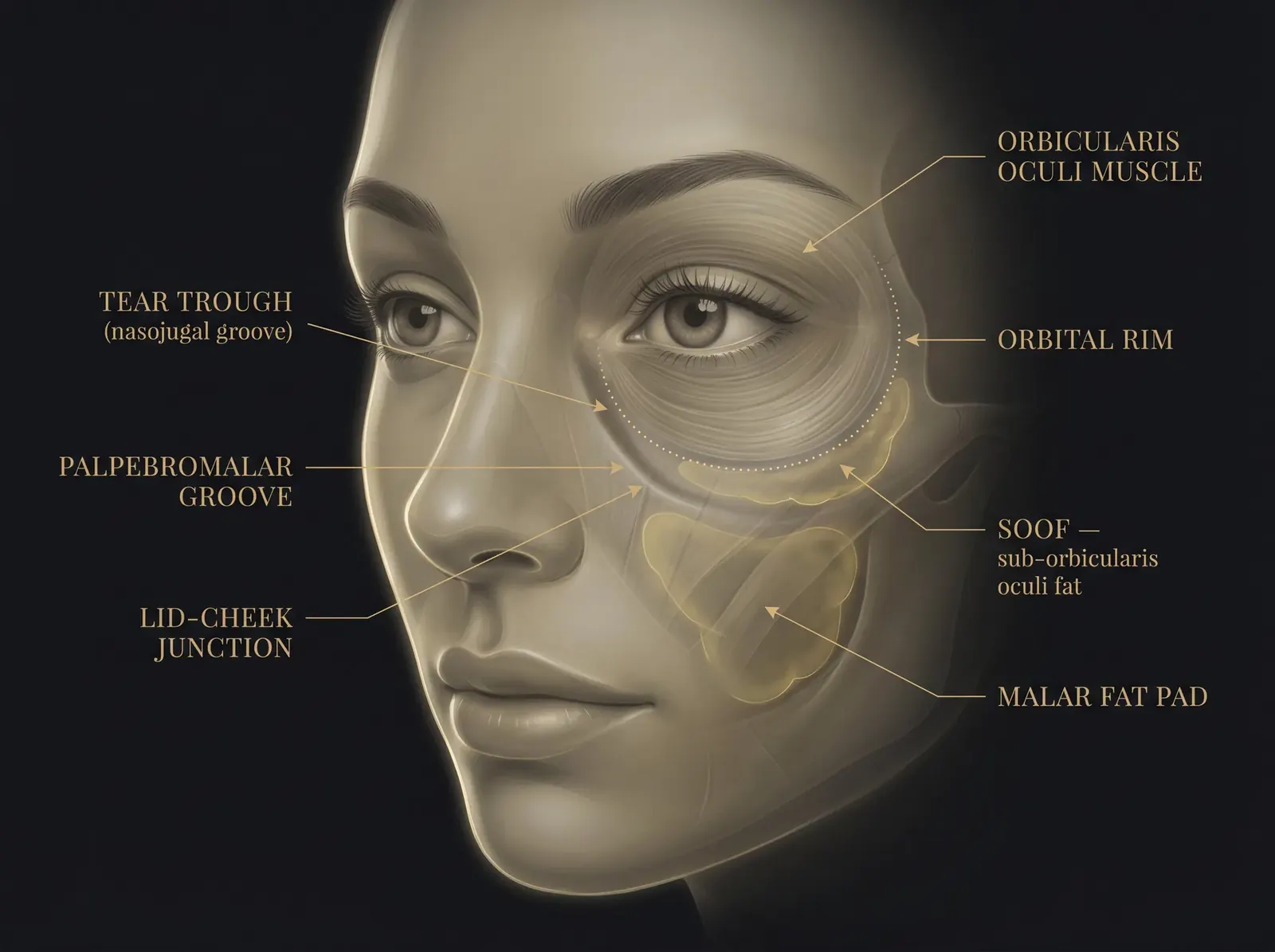
The key landmarks: the tear trough (nasojugal groove) is the medial concave depression along the orbital rim, and it continues laterally as the palpebromalar groove. The deep fat that matters most for safe correction is the SOOF, the sub-orbicularis oculi fat, which sits beneath the orbicularis muscle, directly on bone.
The tear trough is not a wrinkle. It is a true hollow created by where the skin is bound down to the orbital rim, sitting just below the pad of orbital fat that can bulge with age. That is why creams and resurfacing alone rarely fix it: the problem is structural depth, not surface texture.
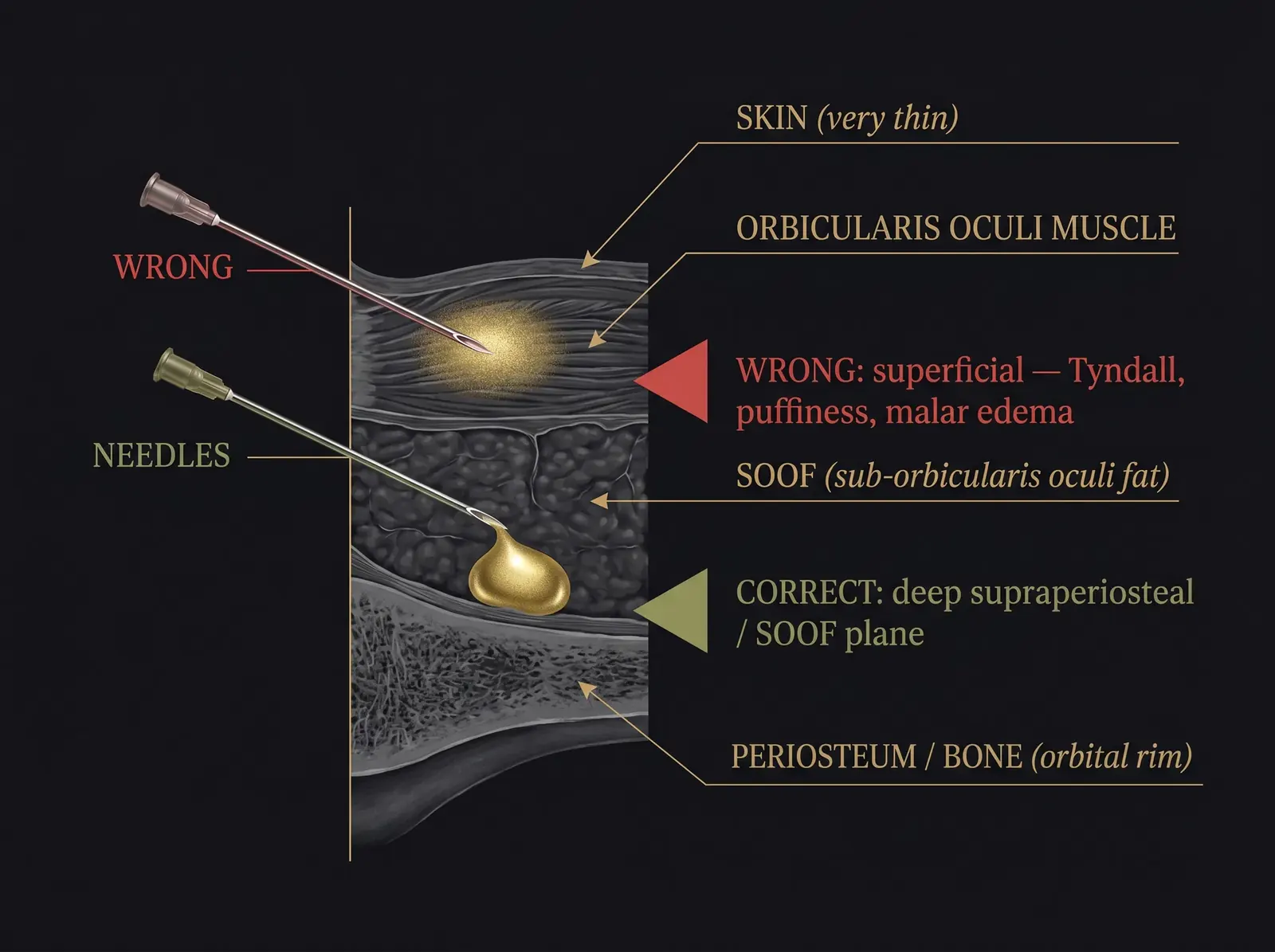
The safest place to support that hollow is deep, on the periosteum, within or beneath the SOOF, far from the thin skin where light can scatter through filler and turn it blue. Place product too superficially and you trade a hollow for a puffy, discolored ridge that can last for months.
In this area, depth is everything. The same product, the same volume, placed two millimeters too shallow, produces a completely different, and far worse, result.
Part 2: Not every under-eye should be filled
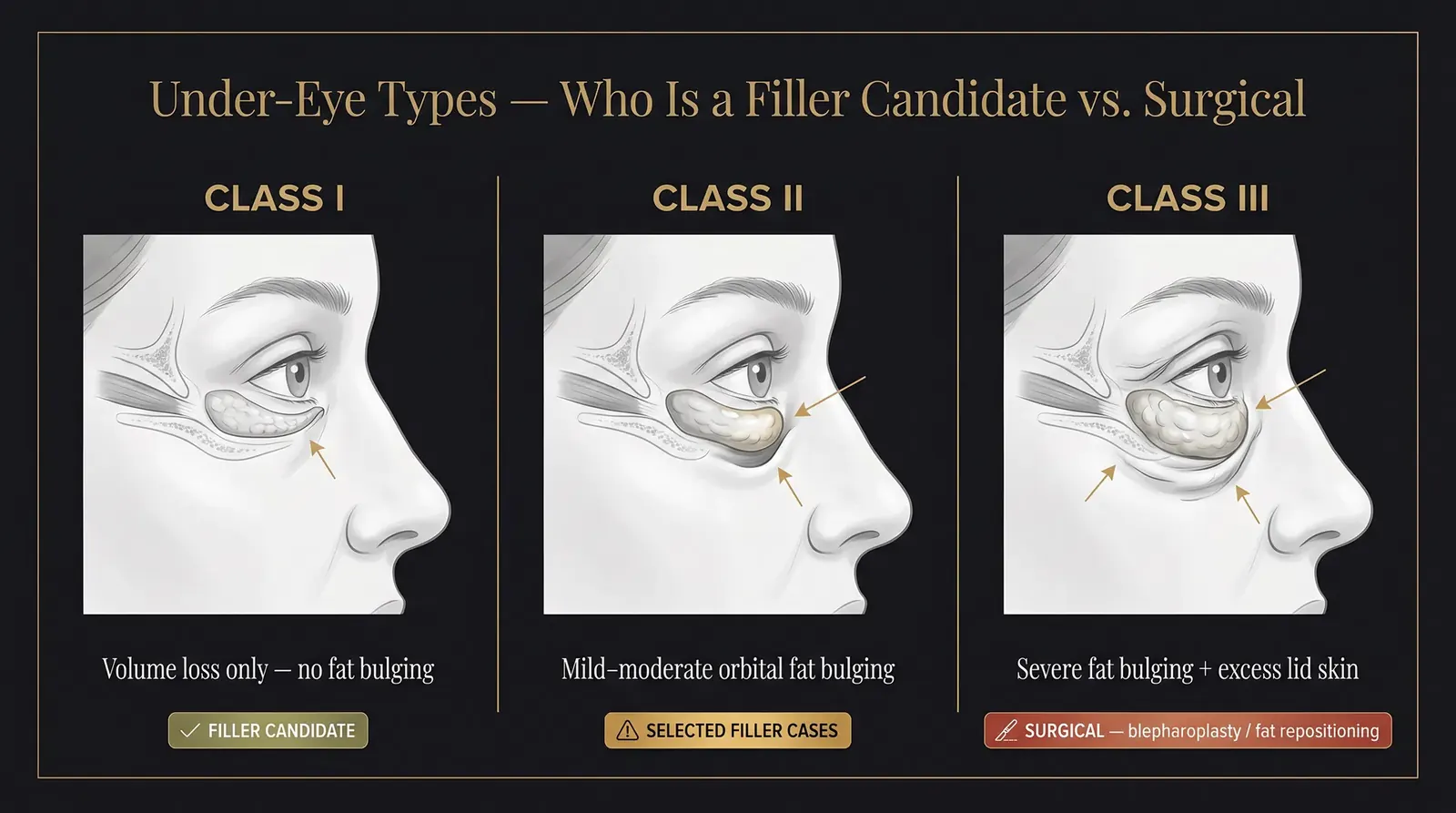
The most important skill in this region is honest candidate selection. A widely used framework (after Jiang et al., Adv Dermatol Allergol 2016;33(4):303–308) grades the under-eye into three types based on how much orbital fat is bulging and whether there is excess lower-lid skin. It maps cleanly onto the single question patients care about: filler, or surgery?
| Class | What it looks like | The right approach |
|---|---|---|
| Class I Filler candidate | A true hollow from volume loss. No real fat bulging, no excess skin. | These patients do beautifully with a small amount of the right hyaluronic acid placed deep, or with PRP/PRF to improve skin quality. |
| Class II Selected cases | Mild-to-moderate orbital fat bulging without excess skin. | Some can still be improved with conservative deep filler to soften the transition, but only after careful assessment. Over-filling here backfires. |
| Class III Surgical | Significant fat bulging plus loose lower-lid skin. | This is the domain of lower blepharoplasty or fat repositioning (arcus marginalis release), not filler. Injecting it usually worsens puffiness and the look of the bags. |
The honest version of this conversation is the most valuable thing a good injector offers. Telling a Class III patient that filler will not serve them, and referring for surgery, protects them from a result they would regret.
Book filler assessment at deRMA Skin Institute. Injected by a board-certified dermatologist in Guelph. Request a consultation first. Book now →
Part 3: The treatment ladder, from platelets to permanent
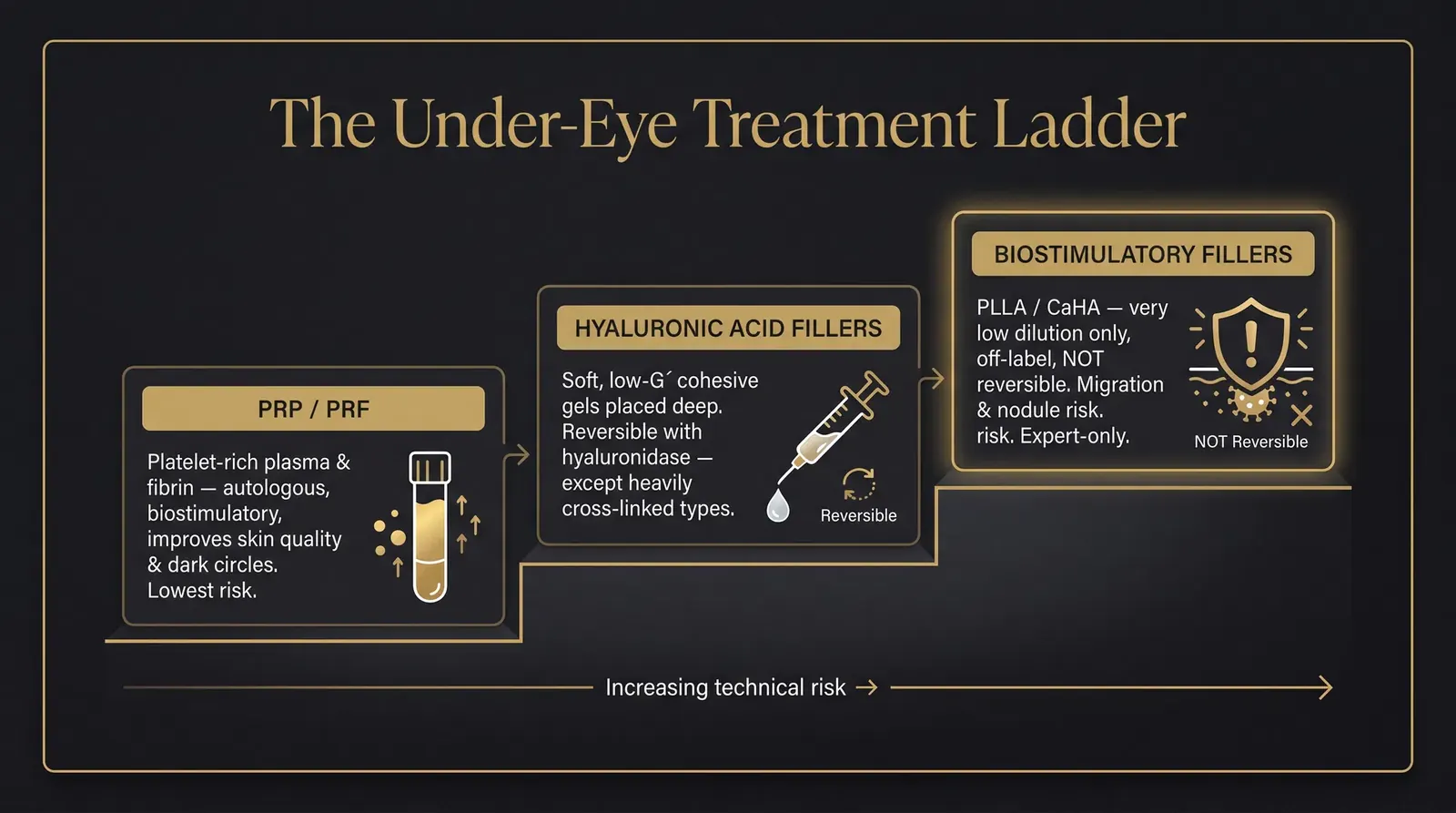
"Filler" is not one thing. There is a ladder of materials, each with a different risk profile and a different ideal candidate. We almost always start at the bottom of this ladder and only climb when the anatomy genuinely calls for it. PRP and PRF are autologous and the most forgiving. Hyaluronic acid is the workhorse and, crucially, reversible. Biostimulators sit at the top: powerful, but unforgiving and not reversible.
1. PRP and PRF (lowest risk)
Platelet-rich plasma and platelet-rich fibrin are drawn from your own blood and spun down to concentrate growth factors. They do not add volume the way filler does; instead they improve skin quality, fine crepiness, and dark-circle discoloration over a series of sessions. Because the material is autologous, there is no product to migrate, no Tyndall risk, and nothing to dissolve. For mild Class I under-eyes, especially pigment and quality concerns rather than true hollowing, this is often the smartest first step.
2. Hyaluronic acid fillers (reversible, with an asterisk)
Hyaluronic acid is the workhorse of the tear trough, but the type matters enormously. The under-eye demands a soft, low-cohesivity, low-water-pull gel placed deep, in tiny amounts (often only a fraction of a syringe per side). A firm, robust cheek-type filler is the wrong choice here and is a common cause of lumps and puffiness.
HA's great safety advantage is reversibility: standard products can be dissolved with hyaluronidase if something is off. The asterisk matters, though. Newer, heavily cross-linked HA fillers resist dissolution and can be far more stubborn to reverse, so "it's just filler, we can always melt it" is no longer universally true.
3. Biostimulatory fillers (expert-only, not reversible)
Biostimulators such as poly-L-lactic acid (Sculptra) and calcium hydroxylapatite (Radiesse) work by stimulating your own collagen rather than adding gel. They can be considered near the under-eye in carefully selected cases, but only at very low dilutions, placed deep and away from the lid margin, because at standard concentrations they carry a real risk of migration and visible nodules in this thin-skinned, mobile area.
The non-negotiable caveat. Biostimulators are not reversible. There is no enzyme that dissolves them the way hyaluronidase dissolves HA. This is exactly why we reserve them for experienced hands and conservative candidates, and why we often do not recommend them in the tear trough at all.
Part 4: The plane decides everything
In the tear trough there is essentially one safe destination: deep, on the periosteum, beneath the muscle. Placed there, a small bolus quietly supports the hollow and is invisible. Placed superficially, the same product scatters light (the blue-grey Tyndall effect) and pulls water into the thinnest skin on the body.
Here is the uncomfortable truth I teach injectors: many genuinely cannot tell which plane they are in. Even with ultrasound, reading these layers and confirming needle or cannula position takes significant, deliberate training. In a region this shallow, that uncertainty translates directly into misplacement, scarring risk, and visible complications.
This is not fear-mongering. It is the reason the under-eye should be treated as an advanced procedure, and why we are candid that it is not the right treatment for everybody.
Part 5: What actually goes wrong, and why
These are not rare horror stories. They are the predictable consequences of the wrong plane, the wrong product, or too much volume. Understanding them is how you choose the right injector.

Malar edema (malar bags)
Fluid that collects in the cheek just below the eye. HA is hydrophilic, meaning it pulls water, and the malar region drains lymph poorly and is partly walled off by the malar septum, so fluid gets trapped. In one retrospective series, roughly a quarter of patients developed prolonged malar edema lasting on average about 5 to 6 months after tear-trough HA. It worsens the very puffiness patients came to fix. The mechanism is a compounding one: water-attracting filler, poor lymphatic drainage, a malar septum that traps fluid, and over-correction or too-superficial placement.
Worsened SOOF and a heavier look
Over-correction or too-superficial placement can accentuate the sub-orbicularis fat and the lid-cheek transition, making the area look heavier and more aged than before treatment. That is the opposite of the goal.
Tyndall effect
A bluish-grey discoloration caused by light scattering through HA placed too close to the surface. It can persist until the product is dissolved.
Migration
Product, especially biostimulators, or HA placed in the wrong plane or in excess, can drift from where it was placed, creating ridges or fullness in unintended areas of a highly mobile region.
Delayed nodules
Inflammatory or hypersensitivity nodules can appear weeks to months later. With HA there is at least the option of dissolving; with biostimulators, management is far more difficult because they cannot simply be melted away.
The reversibility trap
Standard HA dissolves with hyaluronidase, but heavily cross-linked HA can resist it, and biostimulators are not reversible at all. The assumption that any filler can be undone is one of the most dangerous in this area.
Why trust this guide
Dr. Dusan Sajic, MD, PhD, is a dermatology fellowship program director who trains physicians in advanced injectable technique, a key opinion leader and global keynote speaker for aesthetic companies, and a co-author of consensus work on skin quality. His practice is built on linking internal health with external results, and on teaching the plane-control discipline this region demands. You can read more about Dr. Sajic here.
In our training program we see firsthand how many injectors struggle to visualize and confirm the correct plane in the under-eye. That is precisely why we treat it as advanced, select candidates conservatively, and, when the anatomy calls for surgery, say so. Careful, anatomy-led treatment aims for a refreshed, rested under-eye and a smoother lid-cheek transition by restoring structure rather than simply adding volume. Individual results vary, and candidacy is determined only after an in-person or virtual assessment.
Under-eye work also rarely stands alone. It often pairs with regenerative peptide protocols that support skin quality and healing, with CO2 laser resurfacing sequenced alongside collagen-stimulating treatments for full periorbital rejuvenation, and with planning around GLP-1 weight loss, since rapid weight loss deflates the face.
Frequently asked questions
Can filler fix under-eye bags?
It depends on the type of under-eye. True hollows from volume loss (Class I) often respond beautifully to a small amount of the right hyaluronic acid placed deep, or to PRP/PRF for skin quality. But genuine "bags" from bulging orbital fat with loose lower-lid skin (Class III) are a surgical problem; filler alone usually makes them look heavier. Honest candidate selection is the most important step.
What is the safest filler for the tear trough?
A soft, low-cohesivity hyaluronic acid placed deep on the bone, in small amounts, is the standard because it is reversible with hyaluronidase if needed. The under-eye is the wrong place for firm, robust cheek fillers. Biostimulators can be considered only in selected cases at very low dilution by an expert injector, because they are not reversible and carry migration and nodule risk.
Why did my under-eye filler make me look puffy?
The most common reasons are placement that is too superficial, too much volume, or a product that pulls water (malar edema), often worsened by the malar region's poor lymphatic drainage. Superficial HA can also cause a bluish Tyndall effect that reads as puffiness. Most HA-related issues can be improved by dissolving the product and re-treating correctly in the deep plane.
Are biostimulatory fillers safe under the eyes?
Biostimulators such as Sculptra (PLLA) and Radiesse (CaHA) can be considered near, not in, the under-eye in carefully selected cases, but only at very low dilution, placed deep and away from the lid margin, by an experienced injector. The critical caveat is that they are not reversible, so we use them conservatively and often advise against them in the tear trough itself.
Why is the under-eye considered an advanced injection area?
The skin is the thinnest on the body and the correct plane is deep and narrow, so small errors are immediately visible and complications like malar edema can last months. In our physician training program we see that many injectors cannot reliably identify which tissue plane they are in. That is why we treat it as advanced, select candidates conservatively, and refer for surgery when that is the better answer.
Verifiable sources
The anatomy, classification, and complication data in this article are drawn from the peer-reviewed literature below.
- Jiang J, et al. Tear trough deformity: different types of anatomy and treatment options. Adv Dermatol Allergol. 2016;33(4):303–308.
- King M. Aesthetic Complications: Management of Edema. J Clin Aesthet Dermatol. 2017;10(1):E1–E4.
- Hirmand H. Anatomy and nonsurgical correction of the tear trough deformity. Plast Reconstr Surg. 2010;125(2):699–708.
Where this fits at Sajic Longevity. The under-eye rewards honesty and punishes guesswork. Our physician-led team in Guelph (serving Toronto) and Beverly Hills assesses whether you are better served by PRP, conservative filler, or a referral for surgery, and we will tell you honestly if filler is not the right answer. Book a consultation or call 1-888-430-4665.
The under-eye deserves an expert, not an estimate.
Anatomy decides the outcome here. Choose the injector by their understanding of it.
The skin longevity method
Why the core is fixed before anything is injected.
Read more → Book at the clinicBook filler assessment at deRMA Skin Institute
Injected by a board-certified dermatologist in Guelph. Request a consultation first.
Book now → Shop Sajic Skin ScienceRejuvenat corrector cream
Daily DNA-repair support for thin periorbital skin.
Shop now →Not sure which is right for you? Call 1-888-430-4665 or email consult@sajicskin.com and our team will point you to the right starting point.
This article is for education and general information only. It is not medical advice, does not establish a physician-patient relationship, and should not replace consultation with a qualified healthcare provider. Individual results vary. Treatment decisions are made only after an individual assessment.