Stop Guessing. See What Your Skin Actually Needs.
Your skin is changing, but it is not one problem. An international consensus I co-authored breaks skin quality into four parameters: firmness, surface, tone and glow. Each one asks a different question, sits in a different layer, and needs a different tool.
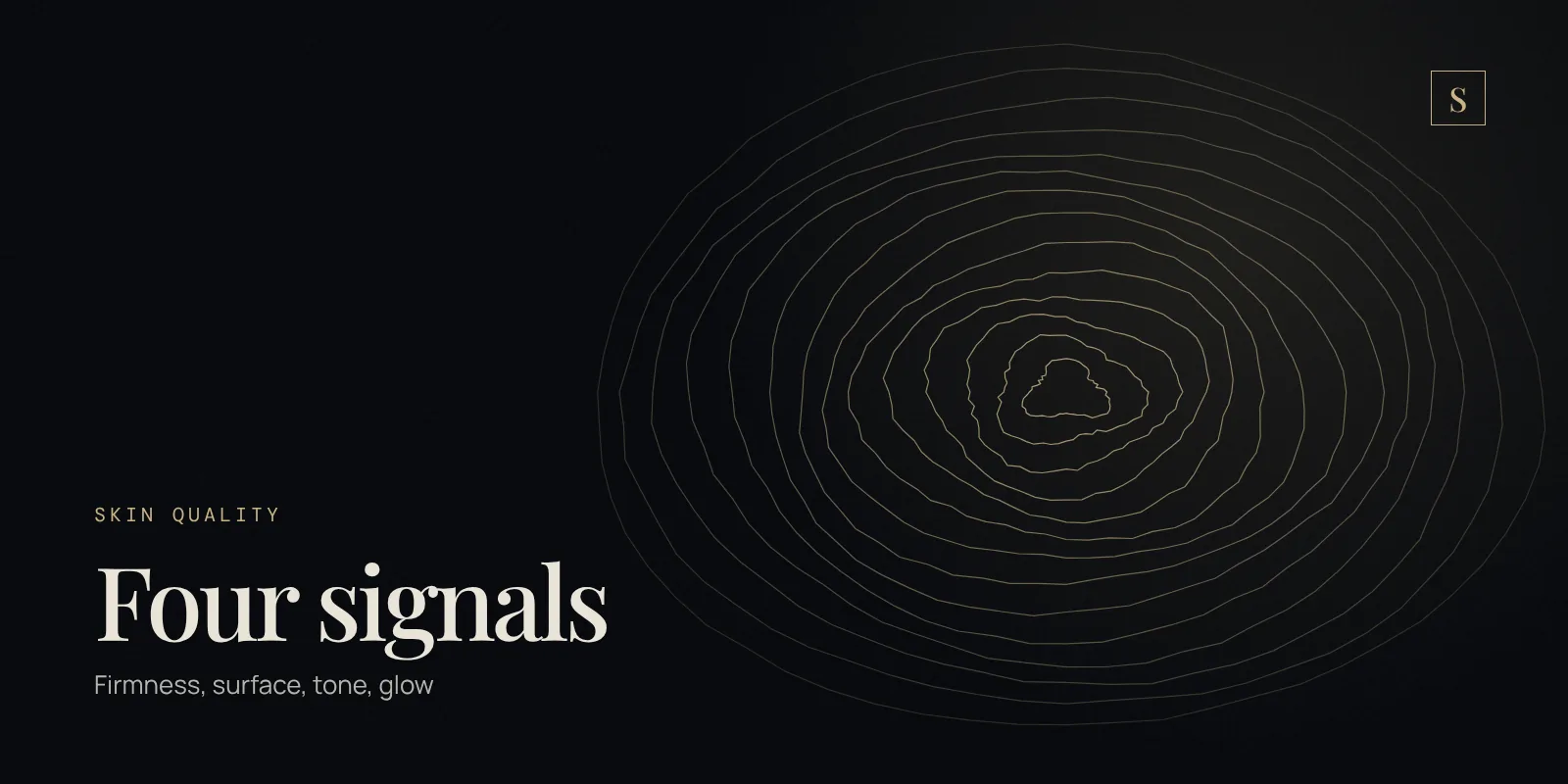
Skin quality is measured across four parameters: mechanical properties (firmness and movement), surface evenness (texture and smoothness), skin tone evenness (colour and clarity) and glow (hydration and radiance). The framework comes from a 2025 international consensus in the Journal of Cosmetic Dermatology, co-authored by Dr. Dusan Sajic of Sajic Longevity. To improve skin quality, assess skin health first, address firmness as the foundation, then sequence treatments for surface, tone and glow.
- Four visible problems, four different questions: stop asking one treatment to do four jobs.
- The consensus treats firmness as foundational and glow as an emergent result.
- Pigment and redness are separate contributors and need separate tools.
- Decide whether maximum outcome, budget or downtime should lead your plan.
- Consensus appropriateness scores are not efficacy or response rates.
Most people describe their skin with one word: tired, dull, older. That word usually hides two or three separate problems sitting at different depths. A softer jawline is not the same problem as rough texture. Brown spots are not the same problem as persistent redness. When one treatment is asked to fix all of them, it tends to fix one and disappoint on the rest.
The four-parameter framework is how I separate those problems before choosing anything. This article converts it into a self-assessment you can use before a consultation, explains how to weigh outcome against budget and downtime, and sets out the sequence the consensus recommends.
What are the four parameters of skin quality?
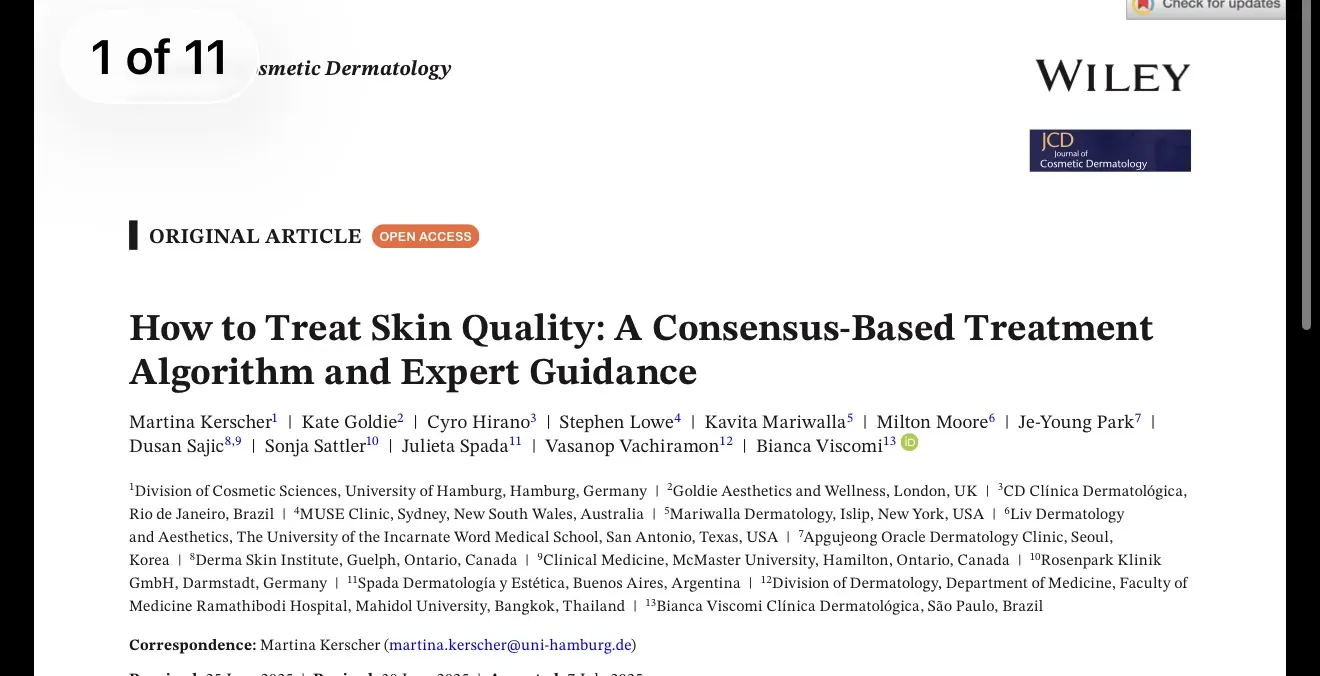
The four parameters are mechanical properties, surface evenness, skin tone evenness and glow. They come from How to Treat Skin Quality: A Consensus-Based Treatment Algorithm and Expert Guidance, published in the Journal of Cosmetic Dermatology in 2025, one of the most comprehensive practical maps of skin quality available. I am a co-author. It builds on the earlier "Skin Quality: A Holistic 360° View" consensus (Goldie et al., 2021).
| Parameter | What it describes | The question it asks |
|---|---|---|
| 01 · Mechanical properties | Firmness and movement | Does your skin still move like you? |
| 02 · Surface evenness | Texture and smoothness | Does light catch every pore, line or scar? |
| 03 · Skin tone evenness | Colour and clarity | Is the problem brown, red, or both? |
| 04 · Glow | Hydration and radiance | Why does rested skin sometimes still look tired? |
How the consensus was built, and what its scores mean
The international panel used a modified Delphi process over two rounds: blind ranking, moderated review, RAND/UCLA appropriateness scoring on a 1 to 9 scale, revision, and final board approval. A treatment category needed a mean score above 6.5 to be included.
Consensus fit is not efficacy. A score of 9.0 means the panel considered a category highly appropriate for that emergent perceptual category (EPC), the consensus term for each parameter. It does not mean 90% improvement, a response rate, or a guaranteed outcome for you.
The limits matter. Merz Aesthetics Global Medical Affairs funded the work, and author industry relationships are disclosed in the publication. Comparative trials are limited, and the rankings rely substantially on clinical experience. Exosomes and growth factors were excluded because the panel considered the evidence insufficient. This is structured expert guidance, not a randomized head-to-head treatment trial.
The four-parameter frameworkHow do you know which skin quality parameter is your main problem?
Separate what you notice into the four parameters, then look at which one dominates. Each parameter has its own visible signs, its own first assessment step, and its own family of treatments. The chapters below take them one at a time.
01. Mechanical properties: does your skin still move like you?
The mirror may show a softer jawline, crepey movement or less bounce, even when the surface looks smooth. Typical signs are laxity or reduced tautness, crepiness with movement, and loss of spring or support.
Firmness is foundational in the consensus algorithm. The panel prioritized treatments that can affect deeper support and mechanical behaviour rather than chasing glow first.
- Assess deeper support and elasticity.
- Discuss microfocused ultrasound with visualization (MFU-V), dilute or hyperdilute calcium hydroxylapatite (CaHA), or fractional remodelling when appropriate.
- Add targeted volume only when anatomy requires it.
02. Surface evenness: does light catch every pore, line or scar?
Texture can make healthy skin look tired because light breaks unevenly across the surface. Typical signs are pores or roughness, fine lines or crepiness, and acne, surgical or traumatic scars.
Surface evenness is not one problem. Pores, wrinkles, scars and crepiness sit at different depths and should not receive one generic procedure. (The same depth logic drives the chemical peel versus laser decision.)
- Name the dominant surface feature.
- Match depth and mechanism: fractional laser, RF microneedling, or selected injectable support.
- Protect the recovery window and reassess before escalating.
03. Skin tone evenness: is the problem brown, red, or both?
A treatment aimed at pigment can miss vascular redness, and a redness treatment can miss pigment depth. Typical signs are brown spots or mottled pigment, persistent redness or visible vessels, and patchy colour after inflammation.
The consensus separates pigment from erythema because they are different biological and optical contributors. Phototype, pigment depth and skin thickness influence risk and device choice.
- Separate pigment from vascular colour.
- Precondition and protect higher-risk skin.
- Select topical, peel, IPL, pigment laser, vascular laser or resurfacing based on the contributor.
04. Glow: why does rested skin sometimes still look tired?
Glow is not glitter. It is how hydration, smoothness, colour and structure work together to reflect light. Typical signs are dullness or low luminosity, dryness or oil imbalance, and skin that looks fatigued despite a full routine.
Glow is the most difficult parameter to quantify. The consensus treats it as an emergent result, usually reached after firmness, surface and tone have been addressed.
- Check hydration, barrier comfort and oil balance.
- Treat the structural, surface or colour driver underneath.
- Use skin-quality injectables, peels, topicals or other selected options only in context.
Book a consultation. Virtual consult: $150 nurse consult (includes SkinLife Analytics) or $499 45-minute physician consult with Dr. Sajic (includes TruAge biological age testing). Deposit applied in full to diagnostic testing. Book now →
Skin quality self-assessment: a checklist to bring to your consultation
Tick every sign that applies to you, then count the ticks in each row. The row with the most ticks is a reasonable first guess at your dominant parameter, but it is a starting point for a conversation, not a diagnosis. Diagnosis and treatment selection require an individual history and examination.
| Parameter | Signs you may notice (tick any) | What gets assessed first | Categories that may be worth discussing |
|---|---|---|---|
| Firmness | ☐ Laxity or reduced tautness ☐ Crepiness with movement ☐ Loss of spring or support | Deeper support and elasticity | MFU-V, dilute or hyperdilute CaHA, selected RF, fractional remodelling, a volume strategy where anatomy requires it |
| Surface | ☐ Pores or roughness ☐ Fine lines or crepiness ☐ Acne, surgical or traumatic scars | The dominant surface feature and its depth | Fractional ablative laser, RF microneedling, selected biostimulation or injectable support |
| Tone | ☐ Brown spots or mottled pigment ☐ Persistent redness or vessels ☐ Patchy colour after inflammation | Pigment versus vascular colour; phototype and pigment depth | Pigment-directed topicals, IPL, pigment or vascular lasers, selected peels, resurfacing |
| Glow | ☐ Dullness or low luminosity ☐ Dryness or oil imbalance ☐ Looks fatigued despite a full routine | Hydration, barrier comfort and oil balance | Barrier care, hydration, selected skin-quality injectables, lifestyle context, after the underlying driver is addressed |
Two adjustments to the count. If firmness has any ticks at all, take it seriously even when another row scores higher, because the consensus treats it as foundational. And if glow scores highest on its own, look again at the other three rows: glow usually reflects a firmness, surface or tone driver underneath.
Before any of this, health comes first. Active inflammation, a changing lesion, or a healing risk is assessed before an elective device is chosen. A suspicious spot belongs in a skin cancer check, not a pigment-laser plan.
How do you balance results, budget and downtime when improving skin quality?
Decide which of the three should lead before you choose a treatment. When several parameters are involved, there are three honest ways forward, and which one fits depends on whether maximum outcome, budget sensitivity or downtime sensitivity matters most to you.
| Path | What it is | When it should lead | The trade-off |
|---|---|---|---|
| Full plan first (comprehensive destination) | A sequenced combination that addresses every parameter you ticked, each with the tool that matches its layer. | Maximum outcome matters most, and you can accommodate several recovery windows over time. | Highest overall investment and the longest timeline. |
| Best single move | The one treatment that may address the most of your concerns at once, typically a category that reaches more than one layer, such as dermal remodelling, which touches both firmness and surface. | Budget is the main constraint and you want the most coverage from one decision. | One treatment rarely does everything; the remaining parameters wait. |
| Simple starting path (good, better, best) | A stepwise entry: a skincare foundation first, then the single targeted treatment for your dominant parameter, then a sequenced combination if you want to go further. | Downtime or simplicity matters most, or you want to see how your skin responds before committing. | Slower, and lighter steps cannot replace a procedure that a structural problem needs. |
None of these is the "right" answer in general. The mistake is choosing a path without knowing which constraint is driving the decision, then judging the result against a different one.
Why combination mattersIn what order should skin quality treatments be done?
Assess health first, build firmness as the foundation, then sequence and combine. The consensus quick take fits in three lines: active inflammation and healing risk come before an elective device; support comes before chasing surface glow; and different layers often need different tools and recovery windows.
One face has several tissue layers. A combination can be logical when each step has a different job. It is not automatically better, and order is not universal.
| Layer | Parameter served | Tools the consensus considers |
|---|---|---|
| Deeper support | Firmness | MFU-V, dilute or hyperdilute CaHA, selected RF, volume strategy |
| Dermal remodelling | Firmness + surface | Fractional ablative laser, RF microneedling, selected biostimulation |
| Optical colour | Tone | Pigment-directed topicals, IPL, pigment or vascular lasers, selected peels |
| Barrier + reflectance | Glow | Barrier care, hydration, selected skin-quality injectables, lifestyle context |
The combination of MFU-V with calcium hydroxylapatite has been systematically reviewed (Amiri et al., 2025), and MFU-V in skin quality has its own narrative review (Pavicic et al., 2025). For how combinations are spaced across a year, see why combination treatments work and the treatment cadence guide. If dermal remodelling with fractional CO2 is part of your plan, preparation changes recovery; the CO2 recovery guide covers that.
The foundation between appointmentsCan skincare improve skin quality on its own?
Skincare builds the base, but it does not replace appropriately selected procedures. Rejuvenat provides a broad multi-active cosmetic base, and Protectif supports daily UV protection. When one parameter remains dominant, physician-directed custom compounded skincare can target the concern, tolerance and pigment risk more precisely. It is built after assessment, not selected from a generic shelf.
What the published GMA formulation study measured
The GMA formulation behind Rejuvenat has published clinical and laboratory endpoints, and they come with boundaries.
Laboratory work also reported changes in UV-induced inflammatory, extracellular-matrix, hypoxia and senescence-associated markers. Those are mechanistic endpoints, not proof that one topical fixes every hallmark of aging.
These products are supportive options, not substitutes for skin cancer screening, prescription treatment, or appropriately selected procedures.
Frequently asked questions
Can a self-assessment diagnose my skin?
No. The four-parameter checklist is an educational framework that helps you describe what you notice. Diagnosis and treatment selection require an individual history and examination.
Is the four-parameter skin quality framework based on a clinical trial?
No. It comes from a two-round modified Delphi consensus involving 12 aesthetic physicians from nine countries, published in the Journal of Cosmetic Dermatology in 2025 and co-authored by Dr. Dusan Sajic. It is structured expert guidance, not a randomized head-to-head treatment trial.
Why does the framework put firmness first?
The consensus considers mechanical support foundational. Treating a surface symptom without considering deeper support can leave the main structural problem unchanged.
What does a consensus score of 9 mean?
It means the panel considered a treatment category highly appropriate for that problem on a 1 to 9 RAND/UCLA scale. It does not mean 90% improvement, a response rate, or a guaranteed outcome.
Does GMA7 replace lasers, injectables or surgery?
No. The published GMA formulation study supports selected topical skin-quality, oxidative-stress and actinic-keratosis endpoints. It does not establish that one topical replaces appropriately selected procedures or medical care.
What is custom compounded skincare?
It is a physician-directed formulation selected for an individual concern, tolerance, pigment risk and routine. Suitability, ingredients, strengths and monitoring are decided after assessment.
Verifiable sources
The 2025 algorithm was funded by Merz Aesthetics Global Medical Affairs. Author conflicts are disclosed in the publication. The algorithm reflects expert consensus; comparative clinical data remain limited. The GMA cohort is small and some participants used a co-treatment.
- Kerscher M, Goldie K, Hirano C, Lowe S, Mariwalla K, Moore M, Park J-Y, Sajic D, Sattler S, Spada J, Vachiramon V, Viscomi B. How to treat skin quality: a consensus-based treatment algorithm and expert guidance. J Cosmet Dermatol. 2025;24(Suppl 4):e70359.
- Goldie K, Kerscher M, Fabi SG, et al. Skin quality: a holistic 360° view. Consensus results. Clin Cosmet Investig Dermatol. 2021;14:643–654.
- Pavicic T, Green JB, Park JY, et al. Microfocused ultrasound with visualization in skin quality: a narrative review. J Cosmet Dermatol. 2025;24(Suppl 4):e70364.
- Amiri M, Meçani R, Niehot CD, et al. Combined MFU-V and calcium hydroxylapatite: a systematic review. Aesthet Surg J. 2025;45(6):638–642.
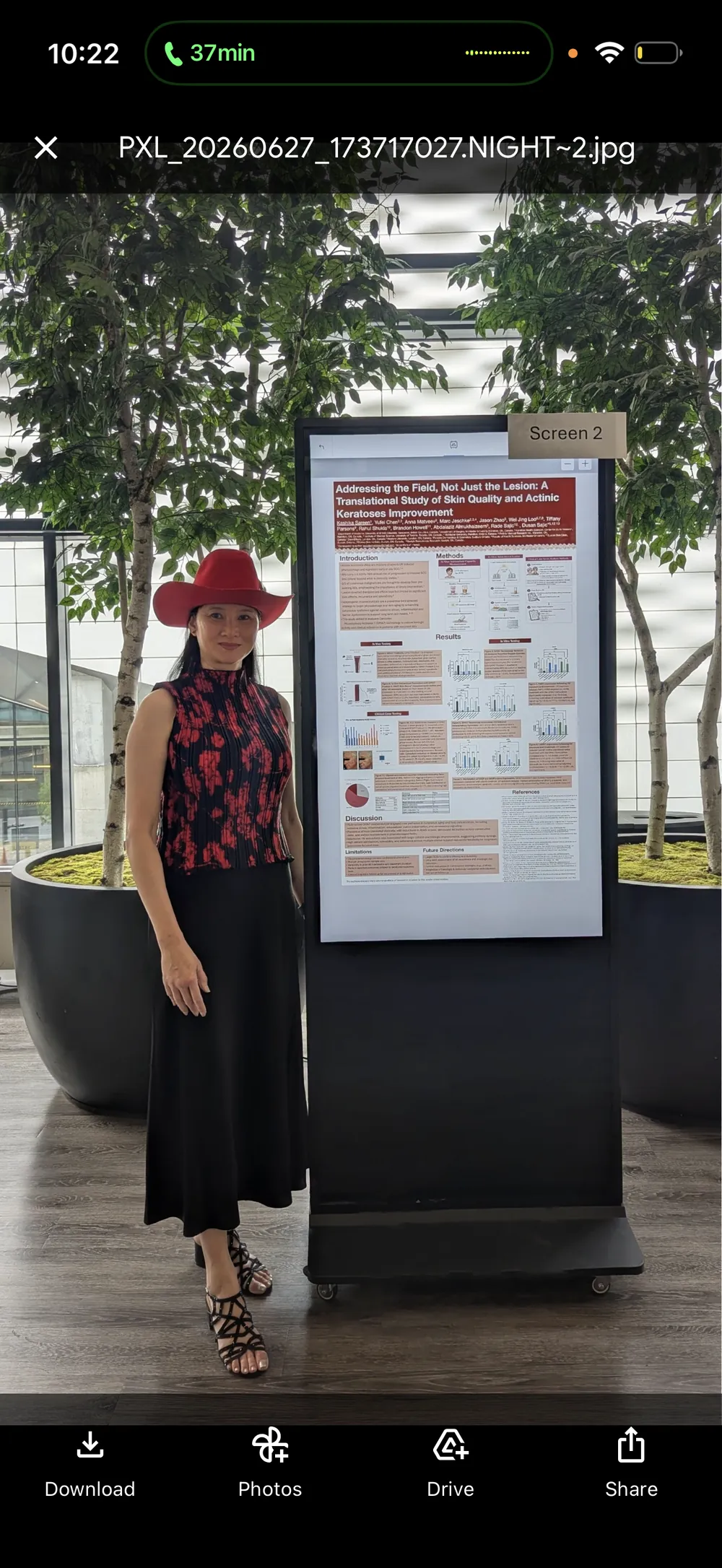
- Sareen K, Chen Y, Matveev A, et al. Novel cosmeceutical to improve skin quality, reduce photodamage and decrease actinic keratoses. Journal of Skin. 2026;10(3):s790.
Where this fits at Sajic Longevity. Tell us what you see. We help separate the dominant parameter, assess safety and healing, and decide whether the next step is skincare, testing, a device, an injectable, or simply a better sequence. Measure the right problem first. Book a consultation or call 1-888-430-4665.
Measure the right problem first.
Separate the dominant parameter, check safety and healing, then decide between skincare, a device, an injectable or a better sequence.
Custom compounded skincare
Physician-directed formulas built after assessment for your concern, tolerance and pigment risk.
Read more → BookBook a consultation
Virtual consult: $150 nurse consult (includes SkinLife Analytics) or $499 45-minute physician consult with Dr. Sajic (includes TruAge biological age testing). Deposit applied in full to diagnostic testing.
Book now → Shop Sajic Skin ScienceGMA7 Ultimate Protection Set
Rejuvenat multi-active base plus Protectif daily UV protection: the foundation between appointments.
Shop now →Not sure which is right for you? Call 1-888-430-4665 or email consult@sajicskin.com and our team will point you to the right starting point.
This article is for education and general information only. It is not medical advice, does not establish a physician-patient relationship, and should not replace consultation with a qualified healthcare provider. Individual results vary. Treatment decisions are made only after an individual assessment.