AI Moved Six Aging Clocks. Did It Reverse Aging?
Rentosertib created a real signal in humans, and an even bigger headline. Here is what happened in the trial, what moved and what did not, what we can measure now, and why the future is not "take this." It is measure, intervene, measure again.
No, AI did not reverse human aging. Rentosertib, Insilico Medicine's AI-discovered TNIK inhibitor, was tested for safety in a 12-week phase 2a trial of 71 adults with idiopathic pulmonary fibrosis (IPF). A later exploratory analysis of stored serum from 42 participants found that several proteomic aging clocks shifted younger, by about 2.71 to 3.46 predicted years in one dose arm at week four. Dr. Dusan Sajic of Sajic Longevity reads it as a genuine human signal that does not prove whole-body rejuvenation, longer life or benefit in healthy people.
- Rentosertib is investigational for IPF and not approved by any regulator. Safety, not aging reversal, was the trial's primary endpoint.
- Four chronological proteomic clocks moved in the 60 mg once-daily arm at week four. Neither mortality clock changed significantly, and results were less consistent by week twelve.
- The clock analysis was exploratory, used 42 of 71 participants, and was led by authors from the company that develops the drug.
- Start with the clinical question. Standard risk labs, body composition and function are usually more actionable than any aging clock.
- Clocks such as TruAge (OMICmAge, DunedinPACE, SYMPHONYAge) are longitudinal adjuncts: measure, intervene, then measure again with the same method.
Did AI reverse human aging in four weeks?
No. The viral headline reads: "AI designed a drug. Six biological-aging clocks moved younger. Aging reversed." It is irresistible, and it is several scientific steps ahead of the data.
What actually happened is narrower and still interesting. A drug designed with heavy AI involvement was tested in people with a serious lung disease. Afterward, researchers ran stored blood samples through six proteomic aging clocks, and some of those clocks predicted a younger age in some dose arms at some time points. That is a real human signal. It is not proof of whole-body rejuvenation, longer life, or benefit in anyone without pulmonary fibrosis.
What is rentosertib and how did AI discover it?
Rentosertib is an investigational small-molecule inhibitor of TNIK, a kinase that a predictive AI system prioritised as an antifibrotic target. A generative chemistry pipeline then produced the molecule. AI helped design the question; humans still had to prove every step.
- AI prioritised. Target selection (TNIK) and molecule generation.
- Scientists validated. Biology, medicinal chemistry, laboratory work and preclinical animal models (Ren, Nature Biotechnology, 2025).
- Humans tested. Phase 1 safety, then a randomized phase 2a trial in idiopathic pulmonary fibrosis (Xu, Nature Medicine, 2025).
- Clocks explored. A later proteomic analysis (Zhavoronkov, Nature Biotechnology, 2026). Not the trial's primary endpoint.
What did the phase 2a trial show?
The trial was a 12-week, double-blind, randomized, placebo-controlled study in 71 adults with IPF, and its primary endpoint was safety. The highest-dose arm showed an encouraging forced vital capacity signal. But liver-related adverse events, and a small, short, geographically limited trial, mean the findings need larger and longer validation. A sponsor-reported phase 3 trial is planned; results do not yet exist.
Book a consultation. Virtual consult: $150 nurse consult (includes SkinLife Analytics) or $499 45-minute physician consult with Dr. Sajic (includes TruAge biological age testing). Deposit applied in full to diagnostic testing. Book now →
Which aging clocks moved after rentosertib, and which did not?
Four chronological proteomic clocks moved younger in the strongest comparison; the two mortality clocks did not change significantly. The analysis used stored serum from 42 trial participants, measured 2,841 proteins after quality control, and ran 54 clock and time-point comparisons per treatment arm. Different algorithms responded differently by dose and visit.
Six clocks means six different questions:
| Clock | Type | What the clock is built to reflect |
|---|---|---|
| ProtAge | Chronological | Predicted age from the serum proteome |
| OrganAge-chrono | Chronological | Predicted age, organ-linked |
| PAC | Chronological | Predicted proteomic age |
| ipfP3GPT | Disease-linked | A proteomic signal linked to pulmonary fibrosis |
| OrganAge-mortality | Mortality | Mortality-linked organ aging |
| PAOPAC | Mortality | Mortality-linked proteomic aging |
What moved, by dose and visit
| Comparison | Result |
|---|---|
| 60 mg once daily, week 4 | −2.71 to −3.46 predicted years across four chronological proteomic clocks (the main-text year-scale result) |
| Mortality clocks, same comparison | Neither changed significantly |
| 30 mg twice daily | Broadest agreement across models, but effects varied |
| Week 12 | Less consistent than week 4 |
Why the mortality clocks matter most
If you care about how long and how well someone lives, the mortality-trained clocks are the closer proxy. They are the ones that did not move significantly. A drug that makes the proteome look younger on a chronological model, without moving a mortality model, has produced a biomarker signal, not an outcome.
Who ran the analysis?
The proteomic clock analysis reported no specific study funding, but the senior author is Insilico Medicine's founder and CEO and several coauthors are employees. Insilico develops rentosertib. That does not invalidate the work. It is context any reader should have, and it is one more reason to wait for independent replication.
A clock change in a small, exploratory analysis of a fibrosis trial is a hypothesis about aging. It is not a treatment for it.
Which biological aging tests should I use now?
Start with the clinical question, not the clock. The safest useful plan begins with established risks and function, then adds aging clocks only when they answer a real question.
The three layers of a measurement stack
- Clinical baseline. Standard disease-risk labs first; a medication, sleep and lifestyle baseline; blood pressure and body composition.
- Function and body. Grip strength, gait, fitness and cognition. Choose one outcome you genuinely want to change.
- Optional aging layer. TruAge: OMICmAge, DunedinPACE and SYMPHONYAge. Use the same laboratory and method every time you retest.
Where TruDiagnostic fits. The current TruAge panel reports OMICmAge, DunedinPACE and eleven SYMPHONYAge organ-system estimates from a finger-stick methylation sample. These are longitudinal adjuncts, not stand-alone diagnoses or permission to start a drug. You can see how we combine them with blood work and imaging on the diagnostics page.
How to choose: match the goal to the baseline
| What you want to change | Start with | Ask your physician |
|---|---|---|
| Metabolic risk | Standard disease-risk labs, blood pressure, body composition | Which result is actually actionable for me, and when do we recheck it? |
| Inflammation | Clinical baseline labs, plus sleep, medication and lifestyle review | What is driving it, and which marker will show whether the plan worked? (See inflammation testing.) |
| Strength and function | Grip, gait, fitness, body composition | Which one functional outcome should we track? |
| Pace of aging | Clinical baseline first, then TruAge (OMICmAge, DunedinPACE, SYMPHONYAge) as an adjunct | Will we retest with the same lab and method, and what would change our plan? |
| Skin recovery | Metabolic health, nutrition, inflammation, sleep, medications and recovery history before procedures | Is my body ready to regenerate the skin we are about to treat? |
| Therapy safety | Indication, history, medications, contraindications and organ function | What are the safety checks and stopping rules for this intervention? |
Are GLP-1s, rapamycin, plasma exchange or peptides proven anti-aging treatments?
No intervention is broadly approved to reverse normal human aging. A treatment can be proven for diabetes, fibrosis, HIV lipodystrophy or another condition without being proven to slow aging in healthy people. Here is how the evidence sorts out.
| Category | Human signal | Still unknown | What to monitor |
|---|---|---|---|
| GLP-1 / incretin medicines | Indication established. Strong outcome evidence for approved metabolic indications: reductions in weight, visceral fat and cardiometabolic events in appropriate patients. A 2026 randomized substudy found some, but not all, epigenetic measures improved. | A clock change does not prove a direct anti-aging drug effect, and lean-mass loss or inadequate nutrition can undermine function. | Indication, body composition, protein intake, resistance training, symptoms, glucose, lipids and organ safety as clinically appropriate. |
| Rapamycin / rapalogs | Emerging. Small human longevity studies such as PEARL (2025) have evaluated low-dose use. | Whether it slows aging or extends healthy life in people. | Requires physician oversight, indication review and safety monitoring. |
| Therapeutic plasma exchange | Emerging. A 2025 randomized clinical trial reported effects on multi-omics aging measures. | Durable clinical benefit in healthy people. | An invasive procedure with its own risks; a clinical setting only. |
| Senolytics / senomorphics | Early. An open-label 2019 study reported fewer senescent cells in people with diabetic kidney disease. | Whether reducing senescent cells improves aging outcomes in humans. (See zombie cells.) | Experimental in longevity contexts; physician oversight. |
| Peptides and hormones | Some are approved for specific indications, for example tesamorelin (FDA label, HIV-associated lipodystrophy). | Most longevity uses are emerging or experimental. | Indication, hormone status and safety checks. See peptides. |
| Supplements, including NOVOS | A 2026 randomized trial of a multi-component supplement reported vascular endpoints; it is a preprint with company involvement. | Peer-reviewed, independent evidence of aging or outcome benefit. | Interactions with medications, and whether the endpoint you care about actually moves. |
Recent work also shows that epigenetic clocks respond differently to different longevity interventions (Nature Medicine, 2026), which is another reason to choose the endpoint before choosing the intervention. This is an educational evidence map only. It does not establish candidacy, prescribe a product, or replace assessment by a licensed clinician who knows your history.
What does "measure, intervene, measure again" look like in practice?
It means every protocol has a baseline, a reason, a safety plan and a recheck. The average response in a paper does not tell you what happened to your biology.
- Measure. Choose a baseline that matches the real goal: disease risk, function, body composition, recovery, or a research-grade aging signal.
- Personalise. Check indication, history, medications, contraindications, nutrition, sleep, training and organ function before choosing an intervention.
- Intervene. Define the outcome, safety checks, stopping rules and a realistic time window before changing the plan.
- Measure again. Use the same method. Ask what moved, what did not, whether function improved, and whether a benefit justified the burden or risk.
The goal is not a single younger number. It is a safer, stronger trajectory across risk, function and quality of life. Our treatment cadence guide covers sensible recheck intervals.
Visible recovery, invisible biologyWhat does this have to do with skin and laser recovery?
The organism decides how well the skin heals. And yes, as I write this, my face currently looks like it is melting. I had laser resurfacing, not simply for appearance, but because controlled resurfacing can ask photodamaged skin to rebuild and remodel. The awkward phase is visible. The biology deciding how well you recover is not.
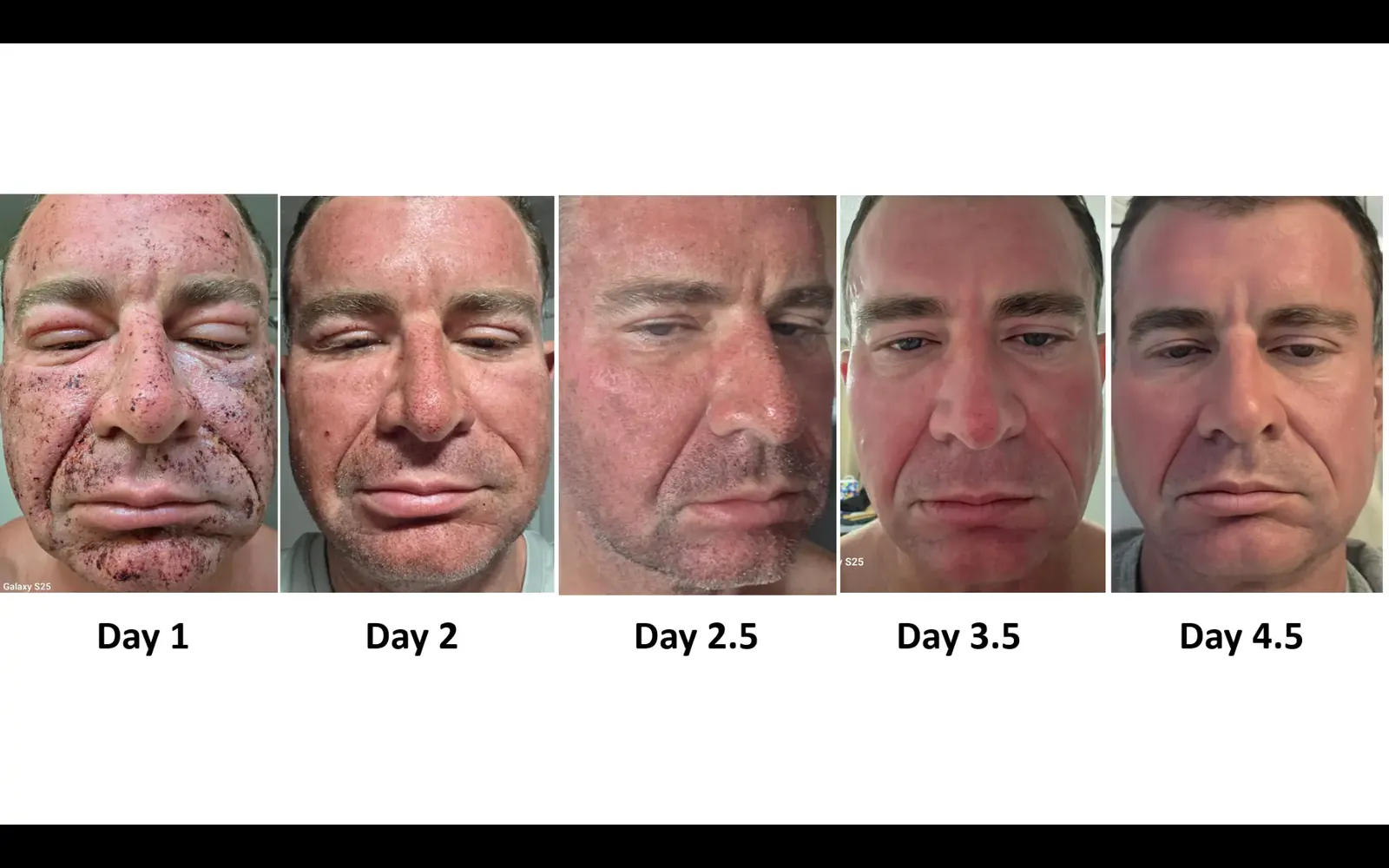
Glucose control, protein and micronutrient adequacy, inflammation, sleep, smoking, medications and immune function can all matter to tissue repair. That is why skin longevity and whole-organism longevity should not live in separate silos. If you are planning CO2 laser resurfacing, read skin recovery science and the CO2 recovery guide alongside this article.
Frequently asked questions
Did rentosertib reverse aging in humans?
No. In an exploratory substudy of a 12-week pulmonary-fibrosis trial, rentosertib shifted several predicted proteomic-age estimates. That does not prove whole-body rejuvenation, longer life, or benefit in healthy people.
What did the strongest four-week result show?
In the 60 mg once-daily arm, four proteomic clocks shifted by about 2.71 to 3.46 predicted years at week four. The two mortality clocks did not change significantly in that comparison, and results were less consistent by week twelve.
Is rentosertib available or approved?
No. Rentosertib is investigational and not approved by any regulator. Its trials have been in idiopathic pulmonary fibrosis, liver-related adverse events were reported, and a sponsor-reported phase 3 trial is planned but has no results yet.
Which biological-aging test should I use?
Start with the clinical question. Standard risk markers, body composition and functional measures are often more actionable. TruDiagnostic can add OMICmAge, DunedinPACE and organ-system estimates as longitudinal adjuncts, but no clock should diagnose disease or determine treatment alone.
Are GLP-1s, rapamycin, plasma exchange or peptides proven anti-aging treatments?
No intervention is broadly approved to reverse normal human aging. GLP-1 medicines have strong evidence for specific metabolic indications and outcomes. Rapamycin, plasma exchange, senolytics and many peptides remain emerging or experimental in longevity contexts and require different levels of medical oversight.
Why measure again after an intervention?
Because study averages do not reveal your response. Repeating the same relevant measures can show whether the intended outcome moved, whether function improved, and whether safety or side effects changed. The interval and tests should match the intervention.
Verifiable sources
The proteomic clock analysis reported no specific study funding, but the senior author is Insilico Medicine's founder and CEO and several coauthors are employees; Insilico develops rentosertib. The NOVOS finished-formula trial is a preprint with company involvement. Small longevity trials can generate hypotheses without proving longer life or broad clinical benefit.
- Xu Z, et al. A generative AI-discovered TNIK inhibitor for idiopathic pulmonary fibrosis: a randomized phase 2a trial. Nature Medicine. 2025.
- Zhavoronkov A, et al. Integration of proteomic aging clocks in a phase 2a clinical trial supports simultaneous geroprotective assessment. Nature Biotechnology. 2026.
- Ren F, et al. A small-molecule TNIK inhibitor targets fibrosis in preclinical and clinical models. Nature Biotechnology. 2025.
- Moqri M, et al. Biomarkers of aging for the identification and evaluation of longevity interventions. Geroscience expert consensus. 2025.
- Chen Q, et al. OMICmAge quantifies biological age by integrating multi-omics with electronic medical records. Nature Aging. 2026.
- Epigenetic clocks respond differently to longevity interventions. Nature Medicine. 2026.
- Semaglutide and epigenetic aging in a randomized human trial. Nature Communications. 2026.
- Kraig E, et al. Participatory Evaluation of Aging with Rapamycin for Longevity (PEARL). Aging. 2025.
- Therapeutic plasma exchange and multi-omics aging measures: randomized clinical trial. 2025.
- Hickson LJ, et al. Senolytics decrease senescent cells in humans: preliminary report from an open-label study in diabetic kidney disease. 2019.
- FDA. EGRIFTA SV (tesamorelin) prescribing information. Revised 2024.
- Piercy C, et al. Acute and 6-month vascular effects of a multi-component nutritional supplement: a randomised controlled trial. SSRN preprint. 2026.
Where this fits at Sajic Longevity. Do not start with the drug. Start with the question. A physician-led consultation matches your goals to the right baseline, separates clinically actionable risk from experimental clocks, decides what is worth repeating, and, if skin procedures are part of the plan, looks at the organism that has to regenerate that skin. No promise that an experimental intervention is appropriate or available. Book a consultation or call 1-888-430-4665.
Do not start with the drug. Start with the question.
A physician-led baseline that separates actionable risk from experimental clocks, then measures again with the same method.
Precision diagnostics
Risk labs, body composition and TruAge (OMICmAge, DunedinPACE, SYMPHONYAge) as a longitudinal adjunct.
Read more → BookBook a consultation
Virtual consult: $150 nurse consult (includes SkinLife Analytics) or $499 45-minute physician consult with Dr. Sajic (includes TruAge biological age testing). Deposit applied in full to diagnostic testing.
Book now → Shop Sajic Skin ScienceRejuvenat corrector cream
GMA7 formulation with DNA-repair enzymes, for the skin side of recovery and photoaging.
Shop now →Not sure which is right for you? Call 1-888-430-4665 or email consult@sajicskin.com and our team will point you to the right starting point.
This article is for education and general information only. Rentosertib is investigational and not approved by any regulator, and this article does not recommend an experimental drug or anti-aging protocol. It is not medical advice, does not establish a physician-patient relationship, and should not replace consultation with a qualified healthcare provider. Individual results vary. Treatment decisions are made only after an individual assessment.